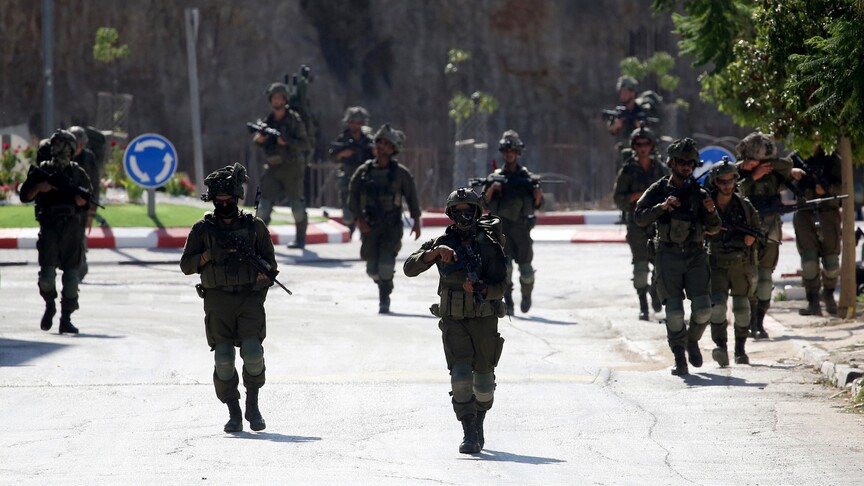
Three Palestinian families in the Jabal Ras al-Ain area of Qusra in the northern occupied West Bank have remained under siege by Israeli occupiers for 11 consecutive days, in the latest in a series of attacks targeting Palestinian residents and their land over the years.
Since Aug. 9, occupiers, under the protection of the Israeli army, have surrounded three homes housing around 13 Palestinians in the town south of Nablus governorate, obstructing the delivery of basic necessities.
Speaking to Anadolu, Qusra Mayor Abdul Azim al-Wadi described how the town has “faced major attacks since 2011,” recalling a series of assaults that included the killing of several residents and the burning of mosques, homes and property.
- Strategic location
Wadi pointed to the burning of Al-Nurayn Mosque in 2011 and Al-Rahma Mosque in recent months, as well as the burning of 47 homes in 2024, in addition to the killings of several town residents in separate attacks.
He said the town faced repeated attempts by occupiers to expand onto its land in 2012, 2013 and 2014, adding that Qusra “stood firm but paid a heavy price.”
He linked what is currently happening in Jabal Ras al-Ain to the area’s geographic location.
The mountain rises about 930 meters (3,051 feet) above sea level and is located in an Area B zone under the Oslo Accords.
“Standing on this mountain, we can see the Mediterranean Sea and Jordan,” Wadi said.
- Army’s collusion
Wadi said the families of Yousef Abdul Salam, Rizq Abdul Salam and Qusay Abu Rida have been under siege since Aug. 9, cut off from the town and prevented from receiving food, medicine and water.
The Israeli army later launched a military operation in Qusra that was initially expected to end Sunday morning but was extended until Tuesday evening, according to the mayor.
Wadi said Palestinians in the town had expected the army’s entry to result in the occupiers being expelled and the siege being lifted. Instead, he said, the army seized one of the homes and turned it into a “military barracks.”
“If the army wanted to, it could arrest or expel the occupiers, but it is a partner in the operation,” he said.
- Shift toward ‘pastoral settlement’
Wadi said Qusra’s land is under threat and that what is happening goes beyond the three besieged families, affecting the future of the Palestinian presence in the area.
He described the current escalation as part of a broader shift in settlement patterns across the occupied West Bank, particularly with regard to “pastoral settlements.”
Palestinians are increasingly seeing tents and prefabricated structures spread across rural areas, he said, arguing that a “pastoral settlement today extends farther than the gun.”
He pointed to the areas of Sinjil, Al-Mughayyir, Turmus Ayya, Aqraba, Qaryut, Jalud and Burin, saying there has been an “evolution in the conduct and violence of occupiers.”
He said this form of settlement expands control over land as outposts, tents and caravans move into areas previously used by Palestinians for farming and grazing.
Qusra, he said, represents one of the focal points of this shift because of its geographic location and its connection to wide rural areas.
The town has faced repeated attacks over the years, he said, but is now confronting a different pattern based on gradual expansion across the land rather than direct attacks alone.
- Siege affects livelihoods, economy
From a location near the besieged homes, Palestinian resident Abdul Hakim al-Wadi provided a more detailed account of the families’ daily lives during the 11-day siege.
“Three homes are besieged by Zionist occupiers, under the watch of occupation soldiers,” he told Anadolu.
He said the Israeli army had turned the home of Yousef Hassan into a military barracks and moved the families to his brother Rizq’s home.
He said the Israeli army ordered a factory located below the homes on the road linking Qusra to the village of Talfit to close until further notice, citing the area’s designation as a “military zone.”
The factory employs 15 workers who support 10 families, he said.
- Struggle for control of land
The developments come as attacks by occupiers have escalated across the occupied West Bank under the protection of the Israeli army.
The UN said it has documented more than 1,430 attacks targeting around 260 Palestinian communities since the beginning of 2026. Occupier attacks, demolitions and evictions have contributed to the displacement of around 3,800 Palestinians, nearly half of them children.
The attacks include the killing and injury of Palestinians, vandalism and demolition of homes and structures, the burning of vehicles and property, the destruction of agricultural land and preventing farmers from accessing their land, according to UN reports.
In Qusra, residents say the attacks have increasingly coincided with the establishment of new illegal settlement outposts and the expansion of illegal pastoral settlements, making the conflict increasingly tied to control of the land.
The Israeli human rights organization B’Tselem said a new illegal settlement outpost was established near Qusra, Jalud and Talfit in January 2026, adding that attacks against Palestinians in the area increased following this.
Israel has occupied the West Bank, including East Jerusalem, since 1967. The international community considers Israeli settlements built on occupied Palestinian land illegal under international law.