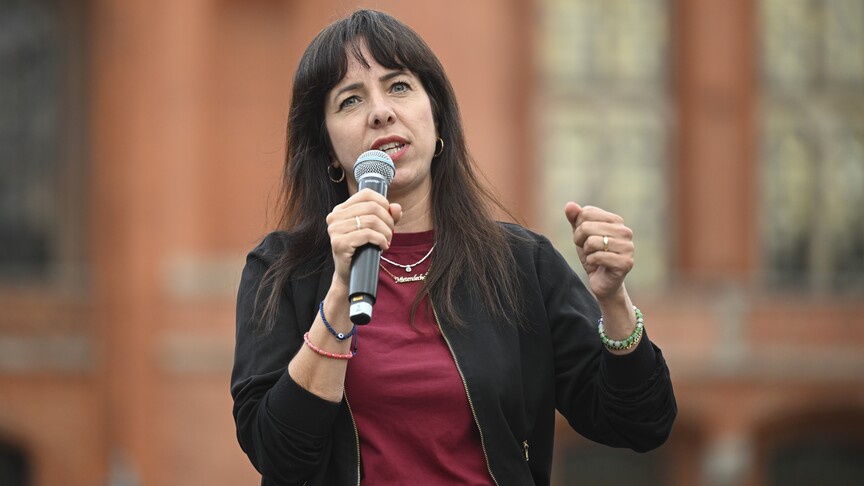
Germany’s capital could get its first mayor from the socialist Left Party and its first with a migrant background if Elif Eralp turns a narrow poll lead into a coalition after Sunday’s state election.
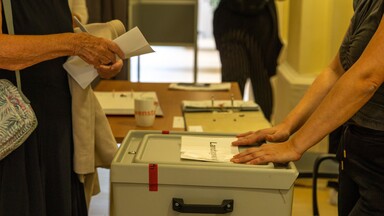
About 2.4 million people are eligible to vote for a new House of Representatives, the parliament of the city-state of Berlin. The lead candidate who can command a majority will become the city’s mayor and head of the state government.
Also in the election, 16- and 17-year-olds will be able to vote for the first time. Polling stations open at 8 am and close at 6 pm local time (0600GMT-1600GMT). Officials have set up 2,542 polling places, with up to 40,000 helpers on duty. First projections are expected after the polls close.
The latest poll by public broadcaster ZDF put the Left Party at 22%, two points ahead of Chancellor Friedrich Merz’s conservative CDU. The right-wing Alternative for Germany (AfD) stood at 18%, the environmentalist Greens at 15% and the center-left Social Democrats (SPD) at 12%. The left-populist Sahra Wagenknecht Alliance (BSW) was at 4%, short of the 5% threshold to enter the Berlin state parliament.
Housing, security split front-runners
The Left Party’s Eralp, a human rights advocate of Turkish origin, has built her campaign around problems she said affect Berliners regardless of income or background — rising rents, costly buses and trains and weak waste collection.
She wants to cap rent increases at city-owned landlords at 1% a year and to build 7,500 municipal apartments annually. Eralp also wants to revive the debate about bringing large private housing firms into public ownership.
Her main rival is CDU lead candidate Stefan Evers, the finance senator in the regional government. His campaign stresses greater security for Berliners and attacks the Left Party as a “security risk,” arguing that it would cut the police budget and abolish the domestic intelligence service.
The right-wing AfD’s lead candidate, Kristin Brinker, has made immigration the centerpiece of her campaign.
She is urging an immediate halt to the intake of asylum seekers in Berlin and quicker deportations of those with no right to stay, including serious offenders. “Apartments are not asylum shelters,” she has repeatedly said, arguing that city housing should take priority for working Berliners.
Rivals clash on Palestinian protests
During the campaign, Evers and Eralp repeatedly clashed about pro-Palestinian demonstrations, which Berlin police have violently repressed in recent years.
While Eralp has strongly condemned the Netanyahu government’s war crimes in the Gaza Strip, she has also pledged to end repressive police tactics.
“The mayor of Berlin never listened to the issues of the Palestinian people here in Berlin, which is a big mistake,” she said.
“We saw a lot of violence and repression against the people. And I want that this stops,” Eralp told Anadolu.
Evers accused the Left Party of failing to take a clear stance against antisemitism among some members. Eralp rejected the charge. “It is absolutely clear that we stand for the protection of Jewish life,” she said. “Just as we stand for the protection of Muslim and Palestinian life.”
Tight race leaves only coalition options
The latest polls point to a close race between the Left Party and the conservative CDU for first place, but no party is expected to win the majority needed to govern Berlin alone.
If the polling holds, the most likely governing option would be a Left Party-Greens-SPD coalition. If Eralp’s party finishes first, it would have the strongest claim to the governing mayor’s office. Green lead candidate Werner Graf has already signaled interest, saying a progressive government would be good for the city.
If the CDU comes first, the main alternative would be a three-party alliance of the CDU, the SPD and the Greens. SPD lead candidate Steffen Krach declined to choose between the CDU and the Left Party during the campaign, saying only: “We’ll look at that after Sunday evening.”
The anti-immigration AfD is projected to almost double its vote share to 18%, up from the last election in 2023. But it has no chance of entering government, as the other parties rule out any cooperation with the party.
Regional votes likely to spark national debate
Berlin votes on the same day as Mecklenburg-Vorpommern. Together, the results will be read as a test of the national mood and of Merz’s grip on the conservative CDU after a run of heavy losses.
Merz canceled a planned trip to New York for the UN General Assembly debate so he can stay in the capital during and after the votes. He and senior CDU leaders are due to meet at party headquarters late Sunday, with talks continuing Monday. CDU lawmakers and their Bavarian sister party, the CSU, are scheduled to gather two days later.
A strong showing by the anti-immigration AfD, paired with another deep defeat for the CDU, could intensify pressure on Merz in the days ahead to step down. A change at the top of the party would not by itself dissolve the federal parliament or force a snap election. If Merz were pushed out, lawmakers could elect a new chancellor without a nationwide vote.