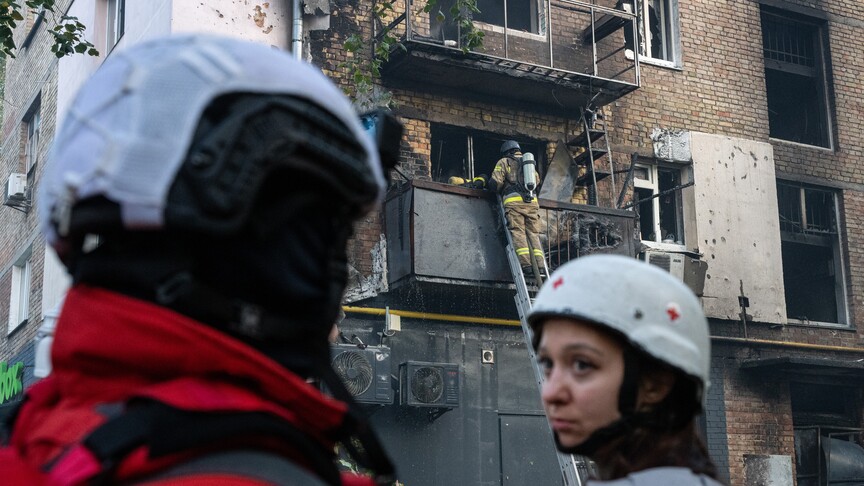
- Russia and Ukraine claim that targeting of infrastructure is linked to military and military-related activities while countries accuse each other of endangering or killing civilians
- Tensions extend beyond Ukraine, with Russia’s westernmost exclave of Kaliningrad adding to friction between Moscow and Europe
Fighting between Russia and Ukraine has intensified since early last month, with attacks increasing in both frequency and scope.
Russia has stepped up attacks targeting Ukraine’s railways, bridges, port infrastructure, electricity facilities and transport hubs, including sites close to the Polish border and in the capital Kyiv.
Ukraine, meanwhile, has intensified attacks deep inside Russia, hitting oil refineries and fuel infrastructure as well as military airfields and air-defense systems.
Both countries deny deliberately targeting civilian infrastructure, maintaining that their strikes are directed at military targets or facilities linked to military activities.
Amid the surge in strikes, tensions between Russia and NATO have also increased, particularly around the Baltic Sea, with Moscow warning NATO that Russia was prepared to use its entire arsenal, including nuclear weapons, if the alliance attempted to isolate its westernmost exclave of Kaliningrad from the rest of Russia.
Russian strikes in Ukraine
Since early September, Russian strikes in Ukraine have killed and injured many people while also damaging local infrastructure in multiple regions, according to reports, including by Ukraine’s State Emergency Service.
Among the reported targets of such strikes were a border checkpoint with Romania on Sept. 6 as well as the building of the My-Ukraina TV channel, part of the country’s United News telethon, on Sept. 8.
Ukrainian President Volodymyr Zelenskyy accused Russia of carrying out “demonstrative strikes” on airports near the country's capital ahead of a planned visit to Kyiv by US envoys Steve Witkoff and Jared Kushner.
The Sept. 6 trip marked Witkoff and Kushner's first visit to Ukraine since US-mediated peace negotiations between Moscow and Kyiv began.
Apart from Kyiv, other Ukrainian regions have also been the target of Russian airstrikes, most notably the southern region of Odesa, where infrastructure and vessels approaching Ukrainian ports have been hit.
On Sept. 12, Ukrainian authorities said at least 48 people were injured following Russian strikes in the region, which Zelenskyy said also hit a hotel in the port city of Chornomorsk.
The Russian Defense Ministry, meanwhile, claimed it hit port infrastructure facilities at the port of Chornomorsk that were “used for unloading and storing military supplies” as well as two dry-cargo vessels and a sea tugboat during overnight strikes.
Railway infrastructure has also been targeted by Russian strikes, with one of the most notable incidents occurring on Sept. 14, when a Warsaw-bound train was hit by a drone near the Ukrainian-Polish border in the Volyn region.
Ukraine claimed that the Russian drone was likely targeting a diplomatic train carrying former British Prime Minister Boris Johnson and other European officials which had left the station before the strike.
Moscow said later that day it was continuing to target railway infrastructure facilities in western Ukraine that were “used for transporting military cargo from European countries.”
Ukrainian strikes in Russia
During the same period, Russia reported extensively on Ukrainian strikes, particularly targeting the energy sector.
Local authorities reported continued strikes on Russian logistics centers, including on Sept. 11, when a drone attack hit facilities belonging to online retailer Ozon.
Ukraine has intensified drone strikes on Russian logistics facilities in a campaign that began in mid-July and has spread across several Russian regions.
Since July, Ukrainian drones have targeted logistics centers of Russia's largest e-commerce retailer Wildberries in multiple regions, and strikes have expanded to facilities belonging to Ozon since August.
Kyiv has alleged that both retailers are playing a role in Russia’s military supply chain, while Moscow and the two companies maintain that the facilities are commercial.
Ukrainian strikes have also continued to target energy facilities across several Russian regions, including the Novorossiysk oil terminal in the southern Krasnodar region and facilities at the port of Ust-Luga in the northwestern Leningrad region.
The sustained attacks have constrained Russia's ability to process crude into transportation fuels. In response, Russia introduced diesel export curbs in July and extended them through September.
US President Donald Trump urged Zelenskyy in mid-September to halt military strikes against Russian diesel refineries, warning that the operations are creating global fuel shortages.
Russia also accused Ukraine of attempting to disrupt its Sept. 18-20 parliamentary elections, during which it said Kyiv targeted local infrastructure, including polling stations. Ukraine did not comment on the accusation.
Kaliningrad tensions
The escalation amid the ongoing war in Ukraine has also become increasingly visible beyond the war-torn country due to rhetoric surrounding Russia's Kaliningrad region.
A Russian semi-exclave bordered by Lithuania to the north and east, Poland to the south, and the Baltic Sea to the west and northwest, the Kaliningrad region has captured media attention after some Russian diplomatic missions in Europe warned that Moscow would use "all weapons" in its arsenal to defend its territory, including nuclear arms.
"Those advocating plans to blockade or strike Kaliningrad should have no illusions about the consequences. Any British or NATO military action against Russian territory would be met with a response using all means at Russia’s disposal, including nuclear weapons," the Russian Embassy in the UK said on Sept. 29.
At a meeting of the Valdai Discussion Club in Moscow last week, Russian President Vladimir Putin also said that any direct attack on Russia or attempt to annex the exclave would inevitably raise the issue of using "all weapons and means at Moscow’s disposal."
Putin's remarks came after reports that Russia had sent a letter to NATO reiterating Moscow's position concerning the Kaliningrad region.
NATO Secretary General Mark Rutte did not disclose the contents of the letter but told journalists on Sept. 30 that the organization had responded.
“We are a defensive alliance,” he said, calling on Russia to "stop the nuclear threats" and “stop the war in Ukraine.”