Ayse Sensoy Boztepe and Gizem Nisa Demir
19 November 2026•Update: 19 November 2026
Zero Waste Foundation President and COP31 Climate Champion Samed Agirbas said a new report estimates that fully implementing circular economy and zero-waste practices could prevent 149 gigatons of greenhouse gas emissions, measured in carbon dioxide equivalent, between 2025 and 2050.
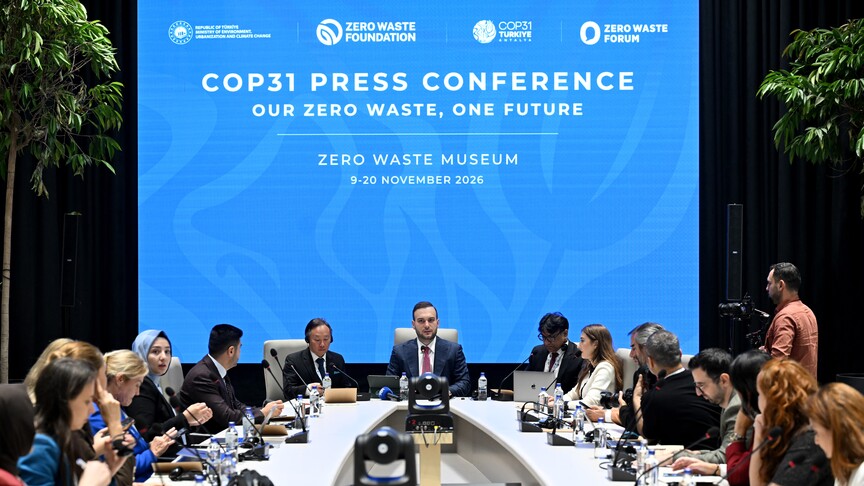
Speaking at a news conference at the Zero Waste Museum conference hall in the Blue Zone during COP31, the UN Climate Change Conference, Agirbas presented the findings of the report, "Our Zero Waste Future" and highlighted the summit's unprecedented scale.
By the end of its first week, the Blue Zone had registered 102,610 participants, while the Green Zone had welcomed 212,000 visitors.
The summit hosted 102 high-level leaders, including 95 national leaders and seven heads of international organizations, with more than 300 ministers taking part in negotiations. The Green Zone also held more than 1,500 panels and sessions.
"These figures are not a list of achievements but an indication of responsibility," said Agirbas.
He said zero waste had been incorporated into the UN climate conference process at an unprecedented level, with its dedicated agenda and platform, marking the transformation of an initiative launched in 2017 in public buildings under the leadership of Turkish first lady Emine Erdogan into a global movement in nine years.
Circular economy could deliver major climate gains
The report, prepared by the Zero Waste Foundation with international scientific contributions, examines the climate benefits of changing how waste is managed.
"The report shows that fully implementing circular economy and zero-waste approaches could prevent 149 gigatons of greenhouse gas emissions between 2025 and 2050. By mid-century, annual savings could reach 9.6 gigatons.
"This amount is greater than the annual emissions generated by all transportation on land, in the air and at sea today," said Agirbas.
He said 37 gigatons of the potential reductions would come from improved waste management, preventing food waste, reuse and repair, while the remaining 112 gigatons would stem from buildings, infrastructure and durable consumer goods.
More than 55% of global greenhouse gas emissions are linked to extracting and processing natural resources, said Agirbas, adding that material production alone generates 11.8 gigatons of carbon dioxide equivalent annually.
Meanwhile, only 6.9% of the global economy is circular, meaning most materials are not returned to the production system.
Organic waste decomposing in landfills and wastewater systems accounts for approximately 20% of human-caused methane emissions, he said, noting that reducing food waste is among the fastest ways to deliver climate benefits.
Agirbas said 2.7 billion people worldwide lack access to regular waste collection, while 845 million tons of municipal waste are dumped indiscriminately, burned openly or discharged into waterways each year.
Most of the solutions outlined in the report are already available, tested and costed, he said, adding that the projected emissions reductions represent achievable gains rather than aspirations.
COP31 has set two targets: reducing projected growth in municipal waste by at least 50% by 2035 and increasing the circular material use rate from 6.9% to at least 15% by the same year. The report outlines a broader vision extending to 2050.
Plastic pollution, women's participation
Global plastic production has increased 230-fold in the last 70 years, exceeding 460 million tons, said Agirbas. Only 9% of plastic waste is recycled, while half is landfilled, 19% is incinerated and the remaining 22% -- approximately 78 million tons annually -- enters the environment uncontrolled.
He said one-third of microplastics originate from washing synthetic textiles, while nearly one-quarter come from tire wear. Approximately 80% of marine plastic pollution originates on land.
"The issue is not just a bottle thrown into the sea, but the most ordinary moments of everyday life," he said.
Agirbas also announced that the Zero Waste Foundation, in cooperation with the Turkish Ministry of Family and Social Services, is recruiting volunteer Zero Waste Women Ambassadors in all 81 provinces of Türkiye.
The initiative aims to develop into a global network of women ambassadors ahead of International Day of Zero Waste on March 30.