- Ruling Democratic Progressive Party seeks to challenge opposition Kuomintang’s dominance in local governments ahead of 2028 elections
- Over 20 million voters eligible to decide whether Taiwan should abandon its nuclear-free energy policy
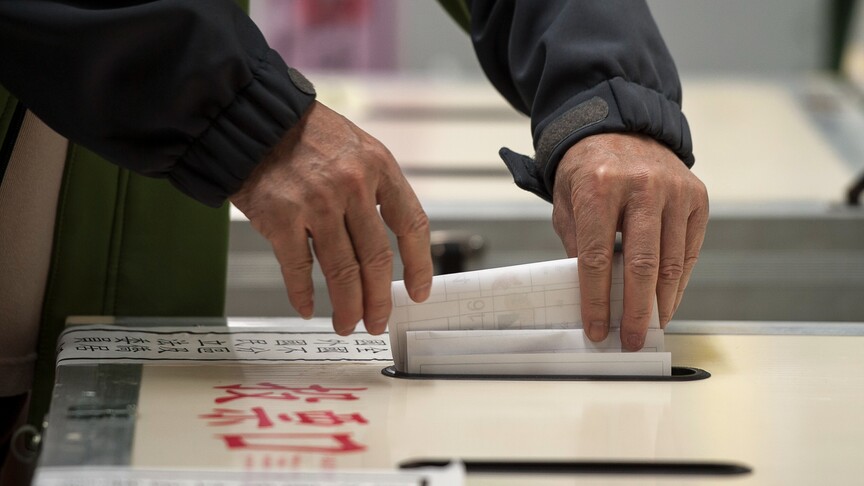
Taiwan will hold its local elections on Saturday, with voters choosing thousands of officials in a contest that could reshape the island’s political landscape ahead of the 2028 presidential and legislative elections.
The vote will be held alongside a nationwide referendum on reversing Taiwan’s nuclear-free energy policy, bringing energy security, electricity costs and industrial competitiveness into focus.
Nearly 19.6 million people are eligible to participate in the local elections, while more than 20 million can vote in the referendum, according to Taiwan’s Central Election Commission, the Central News Agency (CNA) reported.
The elections will fill 11,051 local government positions across six special municipalities and 16 other counties and cities.
Known as the “nine-in-one” elections, the polls are held every four years and cover nine categories of elected office, ranging from municipal mayors to village and borough chiefs.
The voting age is 20 for local elections and 18 for national referendums.
More than 310,000 election workers will participate in Saturday’s voting process, with the election commission expecting counting to conclude by midnight (1600GMT).
Key races and political stakes
The elections will see the ruling Democratic Progressive Party (DPP) attempt to expand its presence in local governments, where the main opposition Kuomintang (KMT) maintains a strong position.
The KMT currently controls 15 of Taiwan’s 22 cities and counties, compared with five governed by the DPP.
Particular attention is focused on the six special municipalities, which include Taiwan’s largest population centers and major industrial hubs.
In Taipei, incumbent KMT Mayor Chiang Wan-an faces DPP legislator Puma Shen, a researcher known for his work on disinformation and foreign influence operations.
Shen is contesting his first direct election and has relied heavily on social media to mobilize supporters, Singapore's Lianhe Zaobao reported Wednesday.
In New Taipei, Taiwan’s most populous municipality, DPP legislator Su Chiao-hui faces former Taipei Deputy Mayor Lee Shu-chuan of the KMT.
In Taoyuan, incumbent KMT Mayor Chang San-cheng is seeking another term against former Deputy Justice Minister Huang Shih-chieh of the DPP.
Taichung will see Deputy Legislative Speaker Johnny Chiang of the KMT compete against DPP legislator Ho Hsin-chun.
In the southern municipality of Tainan, DPP legislator Chen Ting-fei faces KMT legislator Hsieh Lung-chieh.
Another major southern contest is in Kaohsiung, where DPP legislator Lai Jui-lung faces KMT legislator Ko Chih-en.
The DPP and KMT candidates also face smaller-party and independent contenders in several municipalities, according to candidate lists published by CNA and Radio Taiwan International.
Taiwanese leader Lai Ching-te and former leader Tsai Ing-wen have joined the DPP’s campaign efforts, while senior KMT figures have mobilized to defend the party’s northern strongholds, the Taipei Times reported Tuesday.
Campaign issues have largely centered on municipal governance, transportation, environmental protection and development rather than cross-strait relations.
Local governments do not determine Taiwan’s policy toward Beijing, which regards the island as part of China.
However, the election results will provide an indication of public support for the major parties midway through Lai’s four-year term and could influence their preparations for the 2028 elections.
Nuclear power, energy security and economic concerns
Alongside the local elections, voters will decide whether Taiwan should use nuclear energy to support economic development and abandon its policy of creating a nuclear-free homeland.
The referendum was initiated by the KMT and backed by the smaller opposition Taiwan People’s Party (TPP). The legislature approved the proposal in a 59-51 vote in August.
Taiwan stopped generating nuclear electricity in May 2025, when the final operating reactor at the Maanshan Nuclear Power Plant was shut down, completing a phaseout pursued by the DPP since its return to power in 2016.
Growing electricity demand from semiconductor manufacturing, AI infrastructure and other technology industries has since intensified debate over the island’s energy strategy.
Supporters of nuclear power argue that it could provide reliable electricity, reduce exposure to volatile international fossil fuel prices and limit carbon emissions.
During a televised debate organized by the election commission, KMT legislator Niu Hsu-ting argued that nuclear energy could complement renewable power and reduce Taiwan’s vulnerability to disruptions in imported liquefied natural gas supplies, the Taipei Times reported.
Opponents have raised concerns over radioactive waste disposal, earthquake risks, reactor safety and the environmental consequences of potential nuclear accidents.
DPP legislator Chen Pei-yu said any return to nuclear power must address safety, waste management and public acceptance.
She also cited government projections suggesting that Taiwan could meet future electricity demand without nuclear generation.
Lai has nevertheless indicated greater openness to nuclear energy amid increasing electricity demand and geopolitical risks.
On Sept. 24, Taiwan’s Nuclear Safety Commission approved a restart plan for the Maanshan plant, although further safety assessments are required before operations can resume, CNA reported.
Saturday’s vote will be Taiwan’s fourth nuclear-related referendum since 2018.
In 2025, a proposal to restart the Maanshan plant received 4.34 million votes in favor and 1.51 million against but failed to meet the required approval threshold.
Under Taiwan’s referendum rules, affirmative votes must outnumber negative votes and account for at least one-quarter of all eligible voters.
With over 20 million eligible referendum voters this year, the proposal will require at least 5 million affirmative votes to pass.
Voting will take place between 8 a.m. and 4 p.m. local time (0000-0800 GMT).
A successful referendum would require authorities to take steps toward implementing the proposed policy but would not automatically authorize reactor restarts or repeal existing nuclear-related laws, according to legal experts cited by the Taipei Times.
Any resumption of nuclear power generation would remain subject to regulatory procedures and safety assessments.