Strategic cooperation between Ankara and Washington is expanding across all areas, President Recep Tayyip Erdogan said Wednesday, adding that Türkiye seeks to turn political alignment into stronger economic ties.
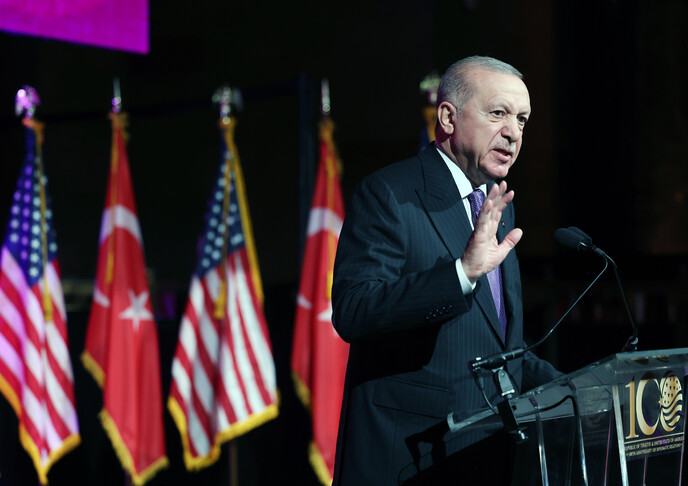
Speaking at the Türkiye-US Business Council meeting held at the Turkish House in New York, Erdogan thanked the American Chamber of Commerce, business councils and the Foreign Economic Relations Board (DEİK) for organizing the meeting.
"We recently finalized major agreements with the US in energy, aviation and other critical sectors through our joint efforts," Erdogan told businesspeople.
“Our strategic cooperation with the US is developing in every area. We want to reflect the harmony we have achieved in our political relations in our economic and trade relations as well.”
He said there is significant potential for further cooperation.
"The US is now our leading LNG supplier. As a result, we are among the leading countries in Europe choosing American energy resources. We aim to expand this cooperation across the entire energy sector, including nuclear energy," he added.
Erdogan said that economic relations between Türkiye and the US should not be viewed solely through trade figures, arguing that a strategic economic cooperation model with Türkiye is needed as the global economic order is being reshaped.
Addressing questions from businesspeople about the state of Türkiye’s economic program and progress toward its targets, Erdogan said the program has four main pillars: price stability, fiscal discipline, a sustainable external balance and structural transformation.
He said Türkiye had made visible progress in all four areas over the past year despite wars in the region.
“Core goods inflation has fallen to its lowest level since 2020, while rent inflation has reached its lowest level in four years. Had it not been for the direct and indirect effects of the war, we would have ended 2026 with inflation in the low 20s. Under current conditions, we expect to end the year at around 28%. We believe 2027 will be a stronger year in terms of disinflation.”
Erdogan said Türkiye was also in a strong position on fiscal discipline.
He noted that tax reductions had been introduced to protect citizens and the real sector from rising fuel prices, while the budget had nevertheless performed better than its target.
The president said Türkiye expects to end the year with a budget deficit equivalent to 3.1% of GDP, compared with an average approaching 6% in comparable countries.
He also highlighted Türkiye’s relatively low public debt, saying public debt is below 22% of GDP, compared with an average of around 78% in developing countries.
Despite higher energy prices, Erdogan said Türkiye had kept its current-account deficit and external debt indicators below their 20-year averages.
'We are accelerating investments supporting digital transformation'
Erdogan said productivity is the central issue and that structural transformation has therefore been placed at the heart of the economic program.
He said Türkiye is pursuing an ambitious green transformation agenda and recalled that Antalya will host COP31 in November.
The president said Türkiye is implementing targeted and selective policies to increase value added in industry.
“We are accelerating infrastructure investments that will strengthen us in artificial intelligence and support digital transformation. In healthcare, we are providing strong incentives to investors through the industrial zone we are establishing in Ankara. We are moving forward decisively toward our goal of a Terror-Free Türkiye to unlock our regional potential.”
Erdogan added that Türkiye is becoming an economy that does not merely react to shocks but invests in resilience, productivity and economic security.
Energy routes are being redrawn
Erdogan said the region is heading toward five major economic and strategic shifts as conflicts subside, with Türkiye positioned to play a central role.
He said global supply chains are being reshaped, with companies increasingly prioritizing reliability alongside cost, benefiting Türkiye’s industrial base and trade links with Europe.
Energy routes are also being redrawn, Erdogan said, highlighting Türkiye’s role in projects such as the Baku-Tbilisi-Ceyhan pipeline and TANAP.
At the same time, new trade corridors are emerging, with the Middle Corridor connecting Asia and Europe and the Development Road linking the Gulf to Europe through Türkiye, he added.
Erdogan said the expected reconstruction of roads, ports, power plants, housing and factories across the region would create new opportunities for Turkish companies, particularly in the construction sector.
He also pointed to the growing importance of defense and advanced technology.
Türkiye's NATO-standard defense industry has reached the capacity to contribute to the supply security of its allies, he added.