Muhammed Enes Yildirim
11 August 2026•Update: 11 August 2026
International researchers who participated in Türkiye’s sixth National Arctic Scientific Research Expedition conducted studies ranging from the effects of climate change on polar ecosystems to the distribution of Arctic bird species and microplastic pollution.
The expedition, known as TASE-VI, concluded after bringing together 12 scientists to carry out 12 projects and studies in oceanography, biology, chemistry, atmospheric dynamics, meteorology, geodesy and satellite systems.
The expedition was conducted under the auspices of the Turkish Presidency, coordinated by the Industry and Technology Ministry and led by the Scientific and Technological Research Council of Türkiye’s Polar Research Institute, or TUBITAK KARE.
Traveling aboard a research vessel as far as 82 degrees north, the team examined priority scientific issues of national and international importance under Türkiye’s National Polar Science Strategy.
The research focused on global climate change, threatened ecosystems and environmental pressures caused by human activity.
Three international researchers from Argentina, Bulgaria and Uruguay joined the expedition to study the effects of climate change on polar ecosystems, the geographical distribution of Arctic bird species and airborne microplastic pollution.
Impact of retreating glaciers on ecosystems
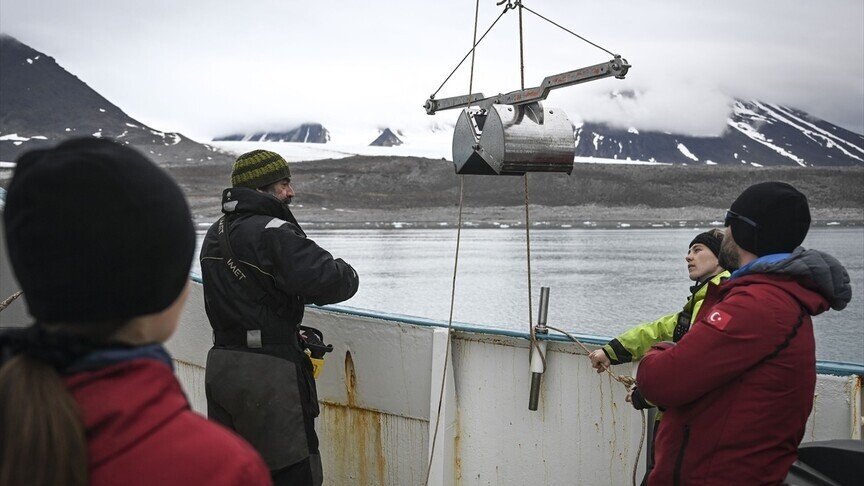
Paula Arbiza, a biologist and Earth sciences master’s student representing the Uruguayan Antarctic Institute, studied Arctic fjord ecosystems affected by glaciers.
Arbiza said the researchers would compare data collected during the expedition with findings from their work in Antarctica.
The study aims to determine how glacier retreat caused by climate change affects the health of surrounding ecosystems.
Researchers collected sediment samples and examined small organisms as biological indicators of ecosystem health while also analyzing environmental variables in the region.
Comparisons between the Arctic and Antarctic are expected to help scientists better understand how polar ecosystems in the two hemispheres are responding to rising temperatures and shrinking glaciers.
Arctic bird populations observed
Boyan Michev of the Bulgarian Academy of Sciences studied the structure of Arctic bird communities and the geographical distribution of species found only in the region.
Michev said researchers were able to observe approximately 30 to 40 bird species over the open sea during the expedition.
Although the birds nest on land, many travel over the sea to feed, allowing researchers to record their presence and distribution along the expedition route.
The observations are expected to contribute to research on how environmental changes affect the habitats, feeding areas and movement patterns of Arctic bird populations.
Microplastics collected from polar atmosphere
Arturo Huber of the Argentine Antarctic Institute investigated microplastic pollution in the atmosphere over the polar region.
Huber said the system used during the expedition collected airborne particles on filters. The samples will be examined in laboratories to determine the concentration of microplastics in the Arctic atmosphere.
The same method was previously used in Antarctica, enabling researchers to compare microplastic pollution in the two polar regions.
Microplastics can be transported over long distances through atmospheric and oceanic circulation, allowing particles originating far from the poles to reach remote Arctic and Antarctic environments.
The comparative research is expected to provide further insight into the scale, sources and movement of microplastic pollution across the planet’s polar regions.