Ugur Aslanhan, Muhammed Enes Yildirim
31 July 2026•Update: 31 July 2026
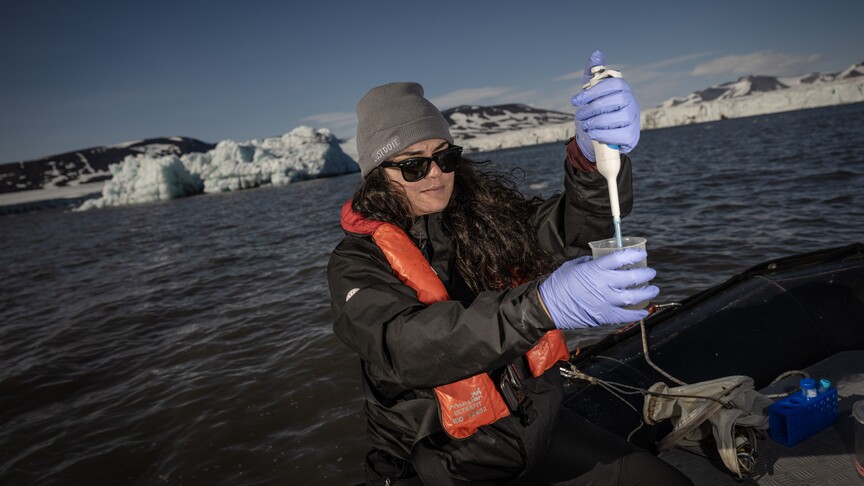
Turkish scientists have completed the country’s sixth National Arctic Scientific Research Expedition, conducting studies on the effects of climate change on marine ecosystems as well as research into space and positioning technologies.
The TASE-VI expedition was conducted under the auspices of the Turkish Presidency, coordinated by the Industry and Technology Ministry and led by the Polar Research Institute of the Scientific and Technological Research Council of Türkiye, or TUBITAK KARE.
The mission included 12 scientific projects spanning oceanography, biology, chemistry, atmospheric dynamics, meteorology, geodesy and satellite systems.
Twelve Turkish scientists participated alongside three researchers from Argentina, Bulgaria and Uruguay.
Traveling by ship as far as 82 degrees north latitude, the team continued research under Türkiye’s National Polar Science Strategy, focusing on global climate change, threatened ecosystems and human-caused environmental pressures.
Professor Denizhan Vardar of Istanbul University’s Institute of Marine Sciences and Management said his team studied how climate change was affecting organisms living on the seabed.
“Our work has two important components. First, we collected images from 28 locations on the seabed to examine the surface coverage of organisms there,” Vardar said.
“We are also using underwater robots and drones to determine the boundaries of the areas where these organisms begin and end. In addition, we are conducting underwater imaging in highly important and interesting locations, particularly areas in front of glaciers.”
Professor Filiz Altay of Istanbul Technical University’s Department of Food Engineering said her two-part project combined nanotechnology, space research and marine biology.
The first part aims to determine the stability of laboratory-produced nanomaterials under simulated space conditions, she said.
“In the other part, we are working to extract vesicles known as exosomes, which enable communication between cells, from fish native to the region,” Altay added.
A medical team also remained on duty throughout the expedition to respond to illnesses and emergencies.
Deputy expedition leader and medical officer Associate Professor Bengusu Mirasoglu said preparations began long before the team traveled to the Arctic, with all participants undergoing detailed medical examinations and tests.
“The purpose of the checks was to prevent potential health risks here, take precautions against illnesses and provide treatment when necessary,” she said.
Participants also received training on basic health issues before departure, Mirasoglu said, adding that the expedition encountered no major medical problems.
Research assistant Ozkan Ozel of Dokuz Eylul University’s Institute of Marine Sciences and Technology said the selection of the Svalbard archipelago was particularly important for understanding the effects of global climate change.
“This is one of the special regions where atmospheric processes interact with seas and ocean waters,” he said. “For oceanographic studies in particular, it acts as a natural laboratory where freshwater and saltwater coexist.”
Conducting research at the same locations for approximately three years would provide valuable long-term data on glacier melt rates, as well as the wider effects of climate change, he added.
Ozel said monitoring the areas where glacial freshwater mixes with seawater would also help scientists better understand the ecosystem around Svalbard and develop projections for the future.
The expedition also tested satellite-based positioning systems under Arctic conditions.
Emre Bozdogan, a research assistant in Gebze Technical University’s Department of Geomatics Engineering, said the team began collecting data with three Global Navigation Satellite System (GNSS) receivers and antennas from their departure point in Tromso, Norway.
“Our aim is to test the performance of different real-time GNSS techniques under Arctic polar conditions,” Bozdogan said.
The researchers will examine whether data losses caused by GNSS signal and correction interruptions can be overcome using kinematic Virtual Reference Station-based positioning software being developed as part of the project.
“We aim to offer uninterrupted positioning capabilities both for our country and for the GNSS literature,” he said.
Murat Curebal, a final-year geomatics engineering student at Istanbul Technical University, also participated after his project examining precise positioning methods in GNSS systems was accepted by TUBITAK.
“I have been interested in the polar regions since the beginning of my university education,” Curebal said. “Thankfully, I have made it here. I hope to participate in many more expeditions. I am extremely excited and happy.”