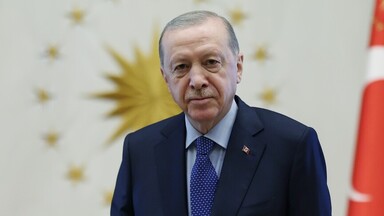
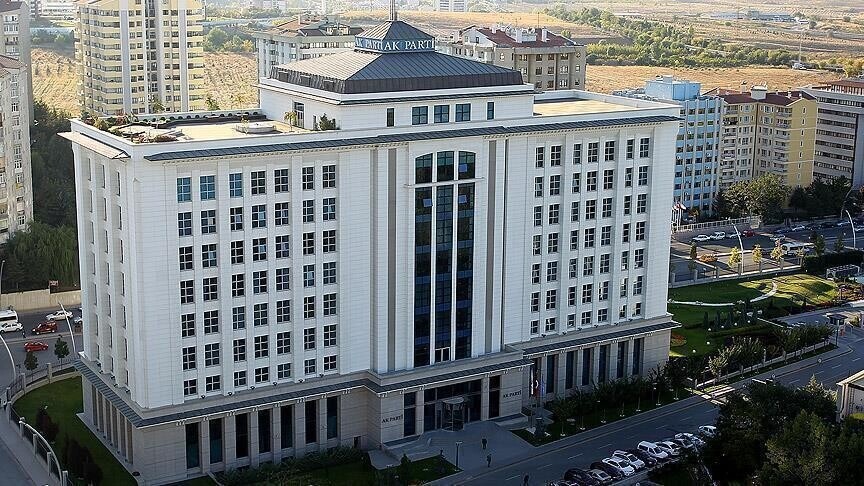
Türkiye's ruling Justice and Development (AK) Party, led by President Recep Tayyip Erdogan, is marking 25 years on the country's political scene.
Its record has been unmatched since the beginning of the country's multiparty era in 1946.
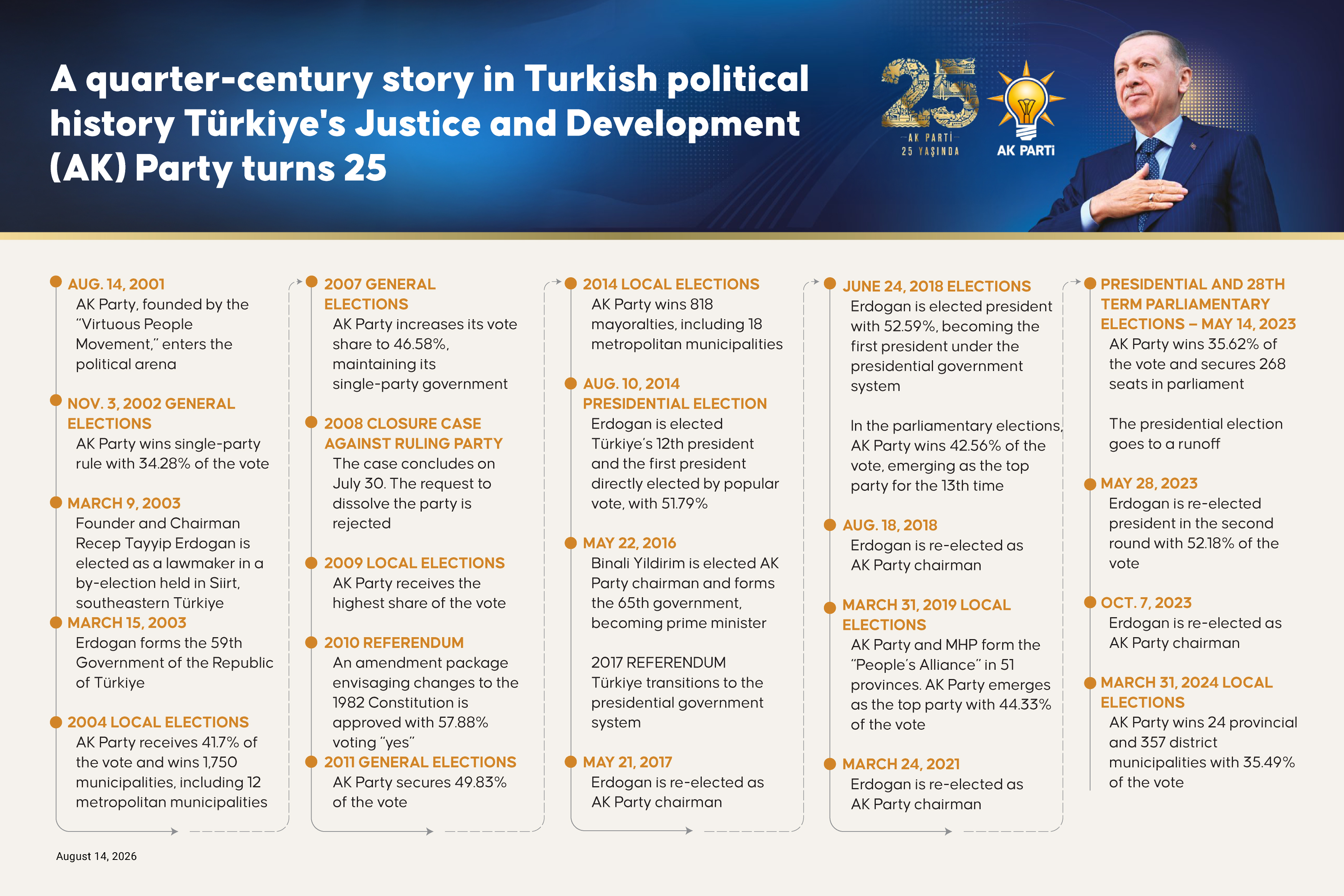
On Aug. 14, 2001, the AK Party was founded as Türkiye's 39th political party, under the “Virtuous People Movement” led by Erdogan, who was then mayor of Istanbul.
“From today onward, nothing will be the same in Türkiye,” Erdogan said at the launch event.
Years later, historians would describe the moment as the beginning of a new era in Turkish politics.
Erdogan was unanimously elected chairman at the AK Party's Founders' Board meeting on Aug. 16. The party's political journey began, eventually producing four prime ministers and two presidents through a series of electoral victories.
Just 15 months after its establishment, the AK Party contested the Nov. 3, 2002, general elections under the slogan “Alone in power, ready to work.”
With Erdogan unable to run due to a political ban, the party won 34.28% of the vote and emerged as the largest party, leading to the formation of the 58th government, headed by Abdullah Gul.
After an amendment to Article 312 of the Turkish Penal Code lifted his political ban, then-party chairman Erdogan was elected as a lawmaker in the March 9, 2003 by-election in Siirt, entering the Grand National Assembly of Türkiye.
Following the resignation of the government led by Gul, Erdogan was tasked by then-President Ahmet Necdet Sezer with forming a government. He established the 59th government on March 15, 2003, becoming prime minister.
The AK Party faced its first electoral test under Erdogan's premiership in the 2004 local elections.
Winning 41.7% of the vote, the party emerged as the largest party and took control of 1,750 municipalities, including 12 metropolitan municipalities.
The AK Party increased its vote share to 46.58% in the 2007 general elections, retaining its single-party government, and also received the highest share of the vote in the 2009 local elections.
An indictment by then-Chief Public Prosecutor of the Court of Cassation Abdurrahman Yalcinkaya, seeking the closure of the AK Party and a five-year political ban on 71 people, including Gul and Erdogan, was submitted to the Constitutional Court on March 14, 2008.
The court's acceptance of the indictment on March 31, 2008, marked the beginning of a new process for the AK Party.
The case, based on an indictment that came to be known in political history as the "Google indictment," was concluded on July 30, 2008.
Six members of the court voted in favor of closing the party, while five voted against. However, the required qualified majority was not reached as required by the Constitution, and the closure case was rejected.
One of AK Party's major political tests came with the 2010 referendum on constitutional amendments, held on the 30th anniversary of the Sept. 12, 1980 military coup.
The amendments were approved with 57.88% of the vote.
The AK Party secured 49.83% in the 2011 general elections and 45.54% in the 2014 local elections, winning 818 mayoralties, including 18 metropolitan municipalities.
Following the end of Gul's term, Erdogan was elected on Aug. 10, 2014, with 51.79% of the vote, becoming Türkiye's first president elected directly by popular vote and the country's 12th president.
Following Erdogan's election as president, Ahmet Davutoglu, a lawmaker from the central Konya province, assumed the AK Party chairmanship.
Under Davutoglu's leadership, the AK Party faced its first electoral test in the June 7, 2015 general elections and subsequently in the Nov. 1 snap elections, when it regained a single-party majority.
At the AK Party's second Extraordinary Congress on May 22, 2016, Binali Yildirim, one of the party's founders, was elected chairman. Yildirim subsequently formed the 65th government and became prime minister.
The July 15, 2016 coup attempt by the Fetullah Terrorist Organization (FETO), one of the bloodiest coup attempts in Türkiye's history, was thwarted after citizens responded to Erdogan's call to gather in city squares and airports and stood against tanks to defend democracy.
The solidarity between the AK Party and the Nationalist Movement Party (MHP) following the coup attempt laid the foundations for the People's Alliance.
The AK Party took another major political step with the April 16, 2017 constitutional referendum.
The groundwork for the referendum was laid on Dec. 10, 2016, when a constitutional amendment proposal signed by 316 AK Party lawmakers, including then-Prime Minister Yildirim, was submitted to the Grand National Assembly.
Following parliamentary votes on the articles, Erdogan approved the constitutional amendment law on Feb. 10, 2017, and sent it to the prime minister's office for publication and submission to a referendum.
The referendum passed with 51.41% voting "yes" and 48.59% voting "no." The provision stating that "the president-elect shall sever ties with his party" was removed from the Constitution, paving the way for Erdogan to retain party membership. Voters also approved the transition to the Presidential Government System.
Following the referendum, Erdogan returned to the AK Party after 979 days, signing a membership declaration and rejoining the party.
At the party's third Extraordinary Grand Congress on May 21, 2017, held following a decision to convene an extraordinary congress, Erdogan was unanimously re-elected as AK Party chairman, receiving all 1,414 valid votes, 998 days after leaving the post.
A law allowing political parties to form electoral alliances opened the way for parties in Türkiye to contest elections in alliances for the first time.
The AK Party and MHP's "People's Alliance" faced its first electoral test in the June 24, 2018 elections.
Following an early election proposal by MHP Chairman Devlet Bahceli, Erdogan and the party's authorized bodies evaluated the proposal, and June 24, 2018, was set as the election date.
Voters went to the polls on June 24 to elect both the president and lawmakers on the same day for the first time.
Erdogan won the presidential election with 52.59% of the vote, becoming the first president under the Presidential Government System, while the AK Party secured 42.56% in the parliamentary elections and remained the largest party for the 13th consecutive general election.
Erdogan took the oath of office in parliament on July 9 and announced the first Cabinet of the new system on the same day.
At the AK Party's sixth Ordinary Grand Congress on Aug. 18, 2018, Erdogan was re-elected chairman with all 1,380 valid votes.
The party's bylaws were amended to incorporate political party electoral alliances following the June 24 elections. A provision was also added stating that membership of the Central Executive Board could not be held concurrently with the position of vice president or minister.
The AK Party and MHP also maintained the People's Alliance in the March 31, 2019 local elections.
The alliance was formed in 51 provinces, including 30 metropolitan municipalities. The AK Party fielded candidates in 27 metropolitan municipalities, while the MHP fielded candidates in Adana, Mersin and Manisa.
The AK Party remained the largest party in the elections, securing 44.33% of the vote.
The AK Party's seventh Ordinary Grand Congress process began in the fall of 2019 at Erdogan's instruction but was suspended after the COVID-19 pandemic began affecting Türkiye in March 2020.
The congress process resumed after pandemic conditions eased, and the congress was held on March 24, 2021, under the theme "Walk the path you believe in." Erdogan was unanimously re-elected chairman with all 1,428 valid votes.
Speaking at the Presidential Complex on March 10, 2023, Erdogan signed a decision under Article 116 of the Constitution to bring forward the presidential and parliamentary elections, originally scheduled for June 18, to May 14.
In the May 14 presidential and parliamentary elections, Erdogan, the People's Alliance candidate, received 49.52% of the vote but failed to secure the more than 50% needed to win in the first round. The AK Party received 35.62% of the vote and won 268 seats in parliament.
In the May 28 runoff, Erdogan won the presidency with 52.18% of the vote.
The AK Party, which has emerged as the largest party in every general election since its establishment, maintained its record as the party with the longest uninterrupted period in power since the beginning of Türkiye's multi-party political era in 1946.
Following the elections, the AK Party held its fourth Extraordinary Grand Congress on Oct. 7, 2023.
Erdogan was unanimously re-elected chairman, receiving all 1,399 valid votes.
The newly elected Central Decision and Administrative Board included 49 new members, while 14 of the 18 members of the Central Executive Board retained their positions.
The AK Party received 35.49% of the vote in the March 31, 2024 local elections, winning 24 provincial and 357 district municipalities.
Following the election results, Erdogan said the party would "surely take the necessary steps by weighing the messages given by the nation at the ballot box in the most accurate and objective manner on the scales of reason and conscience."
Following the election, a renewal process began within the party's organization, with provincial chairmen replaced in Adiyaman, Afyonkarahisar, Erzincan, Gaziantep, Kastamonu, Osmaniye, Zonguldak, Rize, Sanliurfa, Mardin, Kahramanmaras and Batman, as well as several district organizations.
The AK Party held its eighth Ordinary Grand Congress on Feb. 23, 2025, determining the members of its Central Decision and Administrative Board, Central Disciplinary Board, Political Virtue and Ethics Board, and Central Headquarters Party Internal Democracy Arbitration Board.
In the new Central Decision and Administrative Board, 36 members retained their positions while 39 were not included in the new party leadership. With 39 new members joining, 52% of the board was renewed.
The congress also amended Article 81 of the party's bylaws, based on a proposal prepared by the Bylaw Amendment Commission. Three new departments were established for relations with Turkic states, health policies, and culture and arts policies.
Meanwhile, Sevilay Tuncer, the AK Party's head of environmental and urbanization policies, handed over her position to Nilhan Ayan, an AK Party Central Decision and Administrative Board member and Istanbul lawmaker, on April 9, 2026.
Following the eighth Ordinary Grand Congress, a renewal process began within the AK Party's provincial organizations. Provincial chairmen were replaced in 15 provinces: Adana, Adiyaman, Afyonkarahisar, Ardahan, Bitlis, Canakkale, Diyarbakir, Elazig, Giresun, Karaman, Mugla, Nigde, Ordu, Siirt and Tunceli.
Significant progress has been made toward the "Terror-Free Türkiye" goal launched with MHP leader Devlet Bahceli's call on Oct. 22, 2024, and embraced by President Erdogan.
As part of the process, a National Solidarity, Brotherhood and Democracy Commission was established in parliament to work on removing terrorism from Türkiye's agenda, strengthening social cohesion, reinforcing national unity and solidarity, and advancing freedoms, democracy and the rule of law.
The commission was established following a letter sent by Parliamentary Speaker Numan Kurtulmus to political parties represented in parliament and began its work on Aug. 5, 2025.
The commission's report on the National Solidarity, Brotherhood and Democracy was submitted to a vote and adopted by a qualified majority at its 21st meeting on Feb. 18, 2026.
As part of the "Terror-Free Türkiye" process, the Law Proposal on Strengthening National Solidarity and Social Integration was submitted to the Grand National Assembly on Aug. 5, 2026.
The proposal sets out procedures for suspending ongoing investigations, prosecutions and sentences, as well as other measures, once security authorities determine that the PKK/KCK and affiliated groups have ended their physical presence and surrendered their weapons and ammunition, and the National Security Council confirms the development in a decision published in the Official Gazette.
The bill was approved by the Parliamentary Justice Commission on Aug. 8 and passed into law by the General Assembly on Aug. 10, with 467 votes in favor, 87 against, seven abstentions and two duplicate votes.