Mohammad Sio
23 September 2026•Update: 23 September 2026
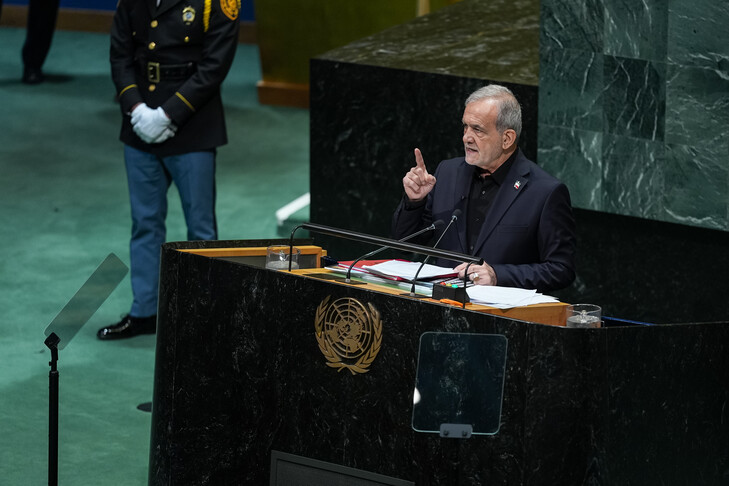
Iranian President Masoud Pezeshkian said Wednesday that Tehran remains open to dialogue and negotiations but will not accept what he described as the “language of force” or talks conducted under threats.
Addressing the 81st session of the UN General Assembly in New York, Pezeshkian said Iran is ready for dialogue but will not submit to pressure.
“We will never bow our head,” he said, adding that Iran is prepared for negotiations provided they are not accompanied by threats.
Pezeshkian said there is clear hypocrisy in the fact that Israel possesses nuclear weapons and is not a signatory to the Nuclear Nonproliferation Treaty, “but the inspectors are requested to come to Iran.”
“They (Israelis) kill, we are sanctioned, we are punished,” he added.
“Israel has murdered savagely over 70,000 innocents in Gaza, but Iran, while behind the table of negotiation, was bombed.”
Pezeshkian reiterated Iran’s claim that it is not pursuing nuclear weapons. However, he said Iran has an “inherent” right to peaceful nuclear technology.
“We will not bow our head and give up the right that is inherently ours,” said the Iranian president.
“We say it clearly: No nuclear weapons and no limitations to peaceful nuclear technology,” he added.
'We are not terrorists, we are victims of terrorism'
He also rejected US President Donald Trump’s characterization of Iran as a sponsor of terrorism.
“Yesterday, Trump said we are terrorists. We are not terrorists; we are victims of terrorism,” Pezeshkian told the General Assembly, referring to Trump’s address a day earlier in which the US president described Iran as the “number one sponsor of terror.”
Pezeshkian said Iran’s leader had been killed “without any justification,” referring to the US-Israeli military attacks against Iran that began earlier this year.
He also accused Israel of targeting neighborhoods across Iranian cities and provinces and carrying out assassinations, describing such actions as “true terrorist” behavior.
“The people of Iran have been defending their country for the past seven months,” Pezeshkian said.
After agreeing to a Pakistan-mediated ceasefire in April, the US and Iran signed the Islamabad Memorandum of Understanding in June, which gave the two sides 60 days to discuss a long-term agreement.
But the two sides soon engaged in retaliatory attacks, and the US reimposed its military blockade of Iranian ports while Tehran closed the Strait of Hormuz.