Rania Abushamala
28 August 2026•Update: 29 August 2026
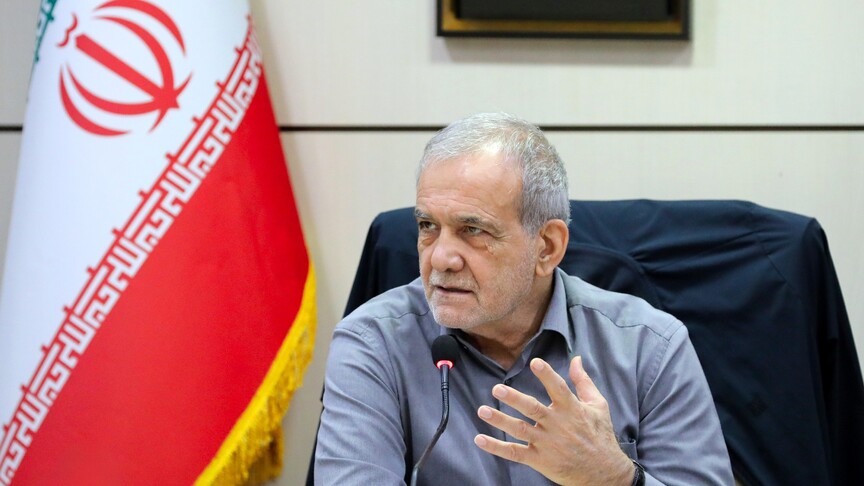
Iranian President Masoud Pezeshkian said Friday that Tehran had agreed with Oman on a passage route through the Strait of Hormuz and would reopen the strategic waterway if the US fulfilled its commitments under the Islamabad Memorandum signed in June.
“We agreed with Oman on the passage route through Hormuz, and if the US fulfills its commitments under the memorandum of understanding, we will open the strait,” Pezeshkian said, according to Iranian official news agency IRNA.
Pezeshkian said the passage route had also been communicated to Iran’s supreme leader.
“We are now following up on the matter. If the US fulfills its commitments regarding lifting the sanctions and blockade, releasing assets, beginning investment and ending the war in Lebanon, we will also open the Strait of Hormuz,” he said.
“As far as the talks have progressed, they also accept that we must return to the memorandum of understanding,” he added, referring to the US side.
Pezeshkian said Iran’s Supreme National Security Council had reached what he called an “exceptional” consensus on the agreement, with 12 of its 13 members voting in favor.
“This collective wisdom was a major achievement,” he said.
The Iranian president said sanctions and the blockade were initially lifted, while negotiations began on releasing frozen Iranian funds and plans were being prepared for $300 billion in investment.
Pezeshkian said Iran’s imports and exports had declined by between 25% and 35%.
He said banking and petrochemical sanctions had been removed under the memorandum and that Iran exported nearly 90 million barrels of oil while the agreement was in effect.
Pezeshkian added that Tehran held discussions with Qatar and the United Arab Emirates on the planned investment, but said the projects could not proceed if the war continued.
Iran, for its part, was working to restore the Strait of Hormuz to its previous status, he added. “But because they did not comply, the memorandum of understanding collapsed.”
Iran and Oman have been holding talks on an arrangement to manage shipping through the waterway since the memorandum agreed between Washington and Tehran collapsed last month.
Under that deal, the US and Iran agreed to extend an April ceasefire and gradually allow shipping through the strait to return to its prewar levels while they held talks on a final settlement to end the war that began in February.
'We are in a state of war'
Turning to domestic energy pressures, Pezeshkian said Iran was facing wartime conditions in which routes were blocked, goods were not entering the country and state revenues had declined, while gasoline still had to be secured.
“We are in a state of war. First, we must understand that we are at war. The route is currently blocked, and goods are not entering. Gasoline is one of those goods,” he said.
The president said the government had not yet decided when to increase gasoline prices or by how much, adding that the only proposal being considered concerned a third pricing tier for consumption exceeding the regular quota.
“The proposed rate for this third quota is around 10,000 tomans ($0.05). Rumors about a price of 50,000 tomans are not true,” he said, adding that consultations with the judiciary and parliament would be required before any measure was implemented.
Pezeshkian also urged greater reliance on public transportation under the current circumstances. “We are in wartime conditions. Our infrastructure, including power plants and oil and gas resources, has been targeted, and energy production has declined,” he said.
He said the government was considering remote work, expanded public transportation, higher vehicle-efficiency standards and the electrification of taxis and motorcycles to reduce fuel consumption without increasing pressure on the public.