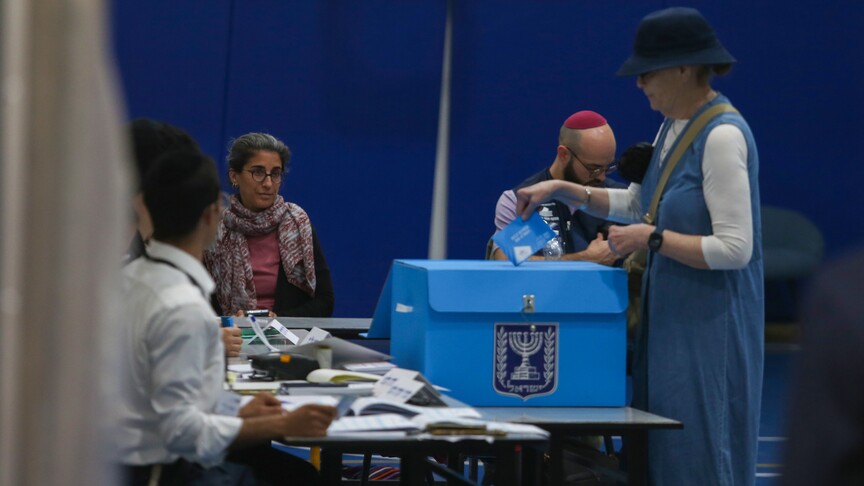
Polling stations in Israel’s closely contested general election will close Tuesday at 10 pm local time (2000GMT), beginning a counting and coalition-building process that could determine whether Prime Minister Benjamin Netanyahu remains in power.
Around 7.3 million voters are eligible to elect the 120 members of the Knesset in Israel’s first general election since the Oct. 7, 2023 attacks and its first held on schedule since 1988.
Final opinion polls placed former military chief Gadi Eisenkot’s Yashar party ahead of Netanyahu’s Likud, but projected neither political bloc securing the 61 seats normally required to form a government.
Here is what to expect after voting ends.
Israeli broadcasters Kan 11, Channel 12, and Channel 13 are expected to release separate exit polls immediately after polling stations close.
The surveys will provide the first estimates of how many seats each party may receive and whether Netanyahu or Eisenkot has a possible route to a governing majority.
Exit polls, however, are projections rather than counted votes. Small differences between the surveys could prove significant because several parties are polling close to the 3.25% electoral threshold.
A party falling slightly below the threshold would receive no representation, potentially shifting several seats between the rival blocs.
Final pre-election surveys projected Yashar winning 22 or 23 seats and Likud receiving between 19 and 21.
Netanyahu’s right-wing and religious alliance was projected to secure around 50 seats, while the main opposition parties were forecast to receive between 52 and 56. Palestinian-led parties were expected to win a combined 14 to 16 seats.
Votes cast at ordinary polling stations will be counted locally after voting ends, with results transmitted to regional counting centers and the Central Elections Committee.
The first official figures are expected to emerge during the night, gradually replacing the television projections.
A clearer picture should be available Wednesday morning, but closely contested seats may remain unresolved.
Israel allocates parliamentary seats nationally through proportional representation. Votes cast for parties that fail to reach the electoral threshold are excluded before seats are distributed among the qualifying lists.
This means the balance of power may change sharply as the count reveals which smaller parties have entered parliament.
The initial count will not include all ballots.
Soldiers, diplomats, hospital patients and staff, prisoners, election workers and voters using specially accessible polling stations cast their votes through a double-envelope system.
Officials first verify the voter’s identity and ensure that the person has not also voted at an ordinary polling station. The identifying outer envelope is then separated from the anonymous ballot before counting.
Approximately 650,000 such ballots are expected, representing enough votes to affect around 14 parliamentary seats.
Their counting is expected to take between 24 and 36 hours and could move parties above or below the electoral threshold, change individual seat allocations and alter the coalition arithmetic.
The final tally is expected by Friday, while the official results are scheduled to be published on Nov. 4.
Finishing first does not guarantee that a party leader will become prime minister.
Once the results are official, President Isaac Herzog will consult representatives of every party elected to the Knesset. Each faction will recommend the lawmaker it believes should be asked to form a government.
Herzog will then assign the task to the member of parliament considered most capable of assembling a coalition, regardless of whether that person leads the largest party.
The first nominee will receive 28 days to form a government and may request an extension of up to 14 days.
If the attempt fails, Herzog may give another lawmaker 28 days to try. If that candidate is also unsuccessful, 61 lawmakers can propose a third candidate, who would have 14 days to build a government.
Failure at every stage would dissolve the Knesset and trigger another election. Netanyahu’s current government would remain in office in a caretaker capacity throughout the process.
Government formation in Israel has taken between 20 and 100 days, and no new government has been sworn in less than 50 days after an election during the past two decades.
Netanyahu’s established alliance consists of Likud, the far-right Otzma Yehudit and Religious Zionism parties, and the ultra-Orthodox Shas and United Torah Judaism parties.
Final polls consistently projected the bloc at around 50 seats, leaving it 11 short of a majority.
To remain in power, Netanyahu would need his alliance to outperform the polls or persuade lawmakers from outside the bloc to support him.
He could seek an agreement with a right-wing opposition party, encourage defections or pursue a broader unity government.
However, most opposition leaders have pledged not to join a Netanyahu-led coalition.
Eisenkot’s potential alliance includes Yashar, the Bennett-Lapid-led B’Yachad party, Yair Golan’s Democrats and Avigdor Lieberman’s Yisrael Beytenu.
Although projected to finish ahead of Netanyahu’s bloc, these parties are also expected to fall short of 61 seats.
Support from the Palestinian-led Joint List or Ra’am could provide Eisenkot with the necessary parliamentary numbers, either through formal coalition participation or outside backing.
But such an arrangement faces major political obstacles.
Lieberman has ruled out serving in a government dependent on Palestinian-led parties, while Eisenkot has avoided committing himself to such a coalition. Netanyahu has also sought to mobilize right-wing voters by portraying Palestinian parties as potential kingmakers.
A minority government could theoretically take office if it received more votes in favor than against during the Knesset confidence vote, but it would face immediate questions about stability.
If neither bloc can assemble a workable majority, pressure could grow for a national unity government involving Likud and one or more opposition parties.
Such an agreement could involve Netanyahu leaving office, a rotating premiership or a limited-term government focused on security and constitutional issues.
Eisenkot and other opposition leaders have rejected serving under Netanyahu, making a unity arrangement difficult unless Likud changes its leadership or accepts a power-sharing formula.
The remaining possibility is another election.
Israel held five general elections between 2019 and 2022 after repeated coalition deadlocks. A similarly fragmented result could return the country to political paralysis, with negotiations rather than Tuesday’s vote determining who ultimately governs.
news_share_descriptionsubscription_contact

contact_the_ombudsman
is_there_an_error_in_this_story