Aysu Bicer and Zuhal Demirci
10 July 2026•Update: 10 July 2026
- The ‘big question’ now is over NATO’s ability to integrate advancing defense industries such as Türkiye’s into its broader military architecture, Ellwood says
- President Erdogan could 'quietly influence' Trump because he respects him, says ex-British minister
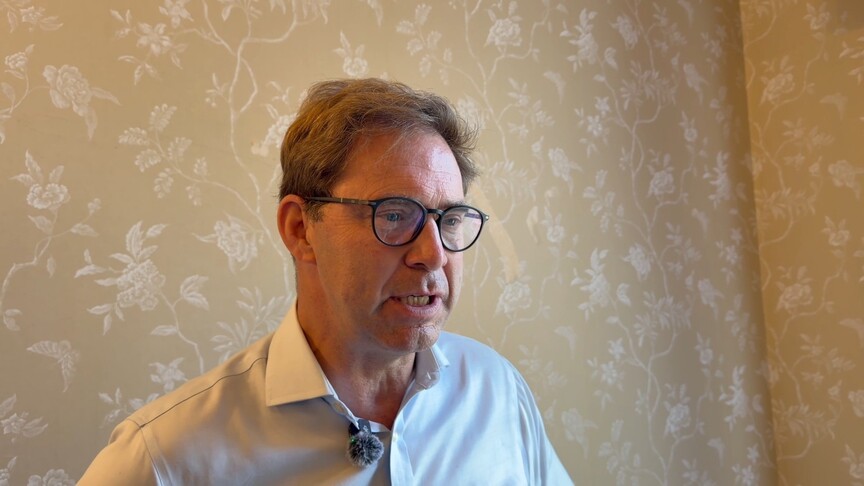
Türkiye used the recent NATO summit to send a clear message that it is no longer merely a regional power but an increasingly influential global player whose voice deserves greater respect, according to former British Defense Minister Tobias Ellwood.
Speaking to Anadolu, Ellwood said the summit served as a clear signal that Ankara is cementing its position as an indispensable, highly capable global player.
"It was good to see Türkiye let people know that their status is rising," he said.
According to Ellwood, Ankara made clear how it expects to be viewed by its allies.
The message was "'treat us with respect – we are now up and coming, we are now a player,'" he said.
He argued that the summit challenged long-held perceptions among some Western allies who have dismissed how Türkiye has “a major influential geopolitical role to play” in the region, particularly in Syria.
Ellwood emphasized that Türkiye's geography gives it a distinctive diplomatic advantage, with “one foot in the Middle East and one in Europe,” while also maintaining “an interesting relationship with Russia as well.”
NATO faces a changing battlefield
While praising the rapid development of Türkiye's defense industry, Ellwood said NATO itself faces mounting challenges as warfare evolves beyond the conventional military threats the alliance was originally created to confront.
"NATO is in a quagmire," he said.
"If you're now having cyberattacks, how does that affect Article 5? If there's space attacks and so forth, how does that affect the NATO alliance?"
"And how do you also get countries to collaborate in space? Everybody's doing their own thing. So, the advance of warfare is challenging NATO, the principles of NATO, and how it works as a deterrent."
He said one of the alliance's biggest tasks will be integrating rapidly advancing defense industries such as Türkiye's into NATO's broader military architecture.
"(Türkiye) has really advanced forward, and the question now is how can you make commonality and interoperability with other NATO countries? That's the big question."
Erdogan could ‘quietly influence’ Trump
Ellwood also argued that Turkish President Recep Tayyip Erdogan occupies a unique diplomatic position because of his relationship with US President Donald Trump.
"It’s interesting that they have a close relationship, and I just wonder whether more could be done with that relationship – whether Erdogan could help steer Trump into a better place," he said.
He suggested Erdogan could play a moderating role within the alliance.
"NATO is an alliance designed to strengthen bonds, and Trump comes in and says things and does things which are disrupting, and I think Erdogan could quietly influence (him) because Trump respects him, in the same way that King Charles respects as well."
He added: "So they have an interesting relationship, and sometimes you have to stand up to Donald Trump, and I'm not sure we do that enough."
'Netanyahu is taking Israel into a bad place'
Beyond NATO, Ellwood voiced concern over developments in the Middle East, sharply criticizing Israeli Prime Minister Benjamin Netanyahu's approach to the region.
"I don't hold back in saying that Netanyahu is taking Israel into a bad place, and he's had the top cover of Trump," he said.
He warned that current policies risk "removing any chance of a two-state solution."
"Many of the problems in the Middle East stem from the fact that we've never resolved this particular issue, that we never built on the Oslo Accords to actually make it happen," he said.
Ellwood argued that lasting regional stability will require cooperation among the Middle East's major powers rather than continued confrontation.
"You've got some big power bases that need to work together," he said.
"In the Middle East, you've got Iran, which isn't going to go away ... You've got Saudi Arabia. You've got Türkiye. You've got Israel. They are the big ones that don't always see eye to eye. And when they don't, that often leads to actual conflict."