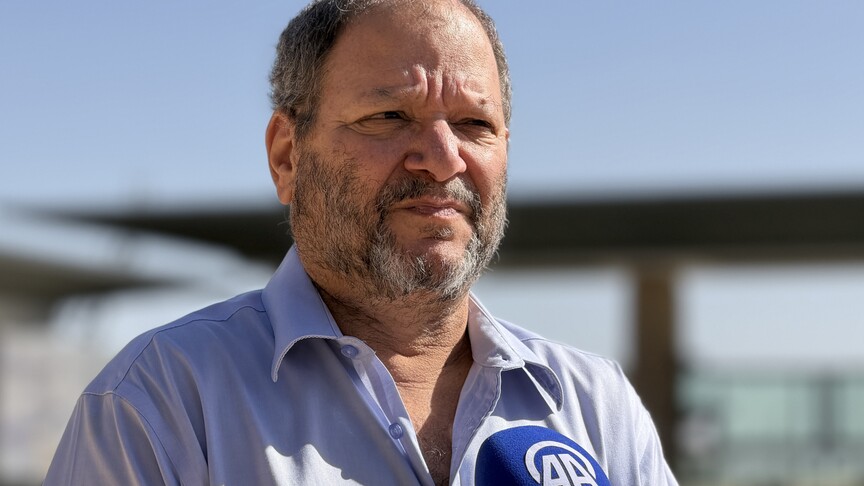
Israeli lawmaker Ofer Cassif said the Joint List will do everything in its power to remove Prime Minister Benjamin Netanyahu’s government in Israel’s Oct. 27 general elections.
“We will do everything we can to get rid of this fascist government,” Cassif, a candidate representing Hadash, the Democratic Front for Peace and Equality, an Arab-Jewish political party and a constituent party of the Joint List, an alliance of Arab-led parties in Israel, told Anadolu in an interview.
Election itself ‘at risk’
Cassif said his first concern was whether the election would take place as scheduled, warning that Netanyahu and his coalition partners could seek to provoke a wider confrontation to postpone or even cancel the vote.
“We have to hope, first of all, that the elections actually take place,” he said.
Cassif said the government could attempt to ignite a major conflict in the occupied West Bank or elsewhere in the region, including Lebanon, Syria, Iraq or Iran.
“They will do everything they can to ignite a fire,” he said, arguing that an escalation could be used as a pretext to postpone the election or boost the coalition’s electoral prospects.
He called the possibility deeply concerning and urged efforts to prevent any further escalation.
Court ruling ‘a right, not a privilege’
Cassif also addressed the Israeli Supreme Court’s decision allowing him and the Joint List to contest the election after attempts to bar Arab lists and candidates.
He said the ruling should not be treated as a favor.
“The right to vote and to be elected is a right, not a privilege,” he said.
The Supreme Court overturned a decision by the Central Elections Committee barring the Joint List and the United Arab List, or Ra’am, and cleared Cassif to run.
Cassif, however, condemned the exclusion of Balad party leader Sami Abu Shehadeh, calling it “outrageous” and warning that similar attempts to exclude Palestinian political representatives could follow.
Arab turnout could shape race
Cassif said efforts to disqualify Arab candidates could ultimately mobilize Palestinian citizens of Israel ahead of the election.
“I believe the attempt to disqualify Sami and to disqualify all of us has mobilized people,” he said.
He predicted a strong showing for the Joint List and said an increased turnout could also attract Jewish voters opposed to the government.
Arab citizens make up around 20% of Israel’s population, while polls project Arab parties to win around 12 to 14 seats in the 120-member Knesset.
Recent surveys show neither Netanyahu’s bloc nor the main opposition camp reaching the 61 seats needed to form a government on its own, potentially giving Arab parties a significant role after the vote.
No automatic support for opposition
Asked whether the Joint List could support opposition leader Gadi Eisenkot in forming a government, Cassif said the question first rested with opposition parties, many of whose leaders have ruled out relying on Arab parties.
“The ball is in their court, not ours,” he said.
Cassif said the Joint List was determined to remove Netanyahu, Finance Minister Bezalel Smotrich and National Security Minister Itamar Ben-Gvir from power.
But he ruled out automatically backing any government that replaced them.
“We cannot support a government that would simply be a carbon copy of the previous one,” he said.
Cassif said policies involving annexation of occupied Palestinian territory or a continuation of the current government’s approach would make such support impossible.
Concern over younger Israeli voters
Cassif also voiced concern over support for extremist political movements among younger Israelis, particularly those serving in the military.
He attributed the trend to sustained incitement against Palestinians, the Israeli left and Jewish opponents of the government’s policies.
Cassif said reversing that trend would require profound political and social change.
“I have to be optimistic,” he said. “But optimism is not just an assumption. It is something we fight for.”
‘Open your eyes and your hearts’
Cassif ended the interview by calling for greater international attention to developments in the occupied West Bank and Gaza.
He accused Israeli occupiers, often accompanied by soldiers, of attacking Palestinians during the olive harvest and called for international action.
“Open your eyes and your hearts, and stop these crimes,” he said.
“Stop the ongoing genocide in Gaza, stop the ongoing ethnic cleansing in the West Bank, and stop the fascism that dominates Israel.”