
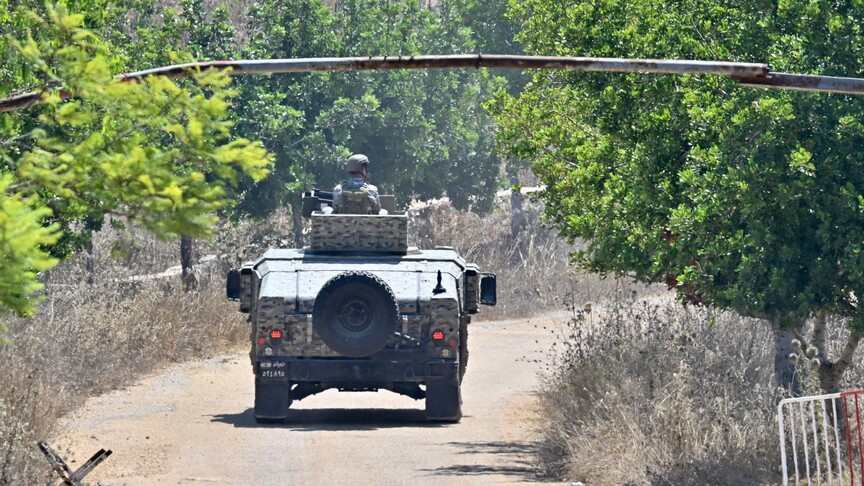
The US has announced the official commencement of "pilot zone" operations in three strategic southern Lebanese villages, marking the first practical step in a complex security framework intended to stabilize the border with Israel.
“Today, pilot zone operations began in the villages of Froun, Srifa, and Zawtar Al-Gharbiya in accordance with the Trilateral Framework,” State Department spokesperson Tommy Pigott announced on Monday.
He characterized the milestone as a direct outcome of high-level negotiations held in Rome last week.
The initiative, managed by the Military Coordination Group for Lebanon (MCG4L), serves as a phased, localized test case designed to re-establish Lebanese state authority and enforce stability along a historically volatile frontier.
Rather than attempting an immediate, full-scale military deployment across the entire region south of the Litani River, the framework isolates small, controllable sectors.
This pilot model allows international observers to evaluate the ability of the Lebanese Armed Forces to maintain exclusive security control before the mission expands toward the Blue Line, the 120-kilometer (75-mile) border demarcated by the United Nations.
The selection of Froun, Srifa, and Zawtar Al-Gharbiya is not arbitrary.
These locations form a strategic geographic crescent across the Tyre and Nabatieh districts, allowing the MCG4L to test implementation across distinct terrains: a population center, a valley network, and a river overlook.
Srifa serves as the major central hub in the Tyre District, located 90 kilometers south of the capital Beirut.
As one of the largest villages in southern Lebanon, it sits in hilly terrain that has historically been a focal point for regional security. Testing the Lebanon army's presence here provides an operational foothold in a sensitive inland sector.
Froun, situated in the Bint Jbeil District of the Nabatieh Governorate, is positioned near dense valley systems. Its geography makes it a critical point for monitoring non-state armed presence.
Zawtar Al-Gharbiya, or Western Zawtar, is perhaps the most tactically sensitive of the three. It sits directly on the bluffs overlooking the Litani River valley, acting as a gateway between the northern hinterland and the southern border zone.
Notably, Zawtar Al-Gharbiya is the only one of the three villages currently occupied by Israeli forces, making it the primary site for the initial phased withdrawal of the Israeli military.
The Lebanese army confirmed on Monday that its tactical units are currently executing security missions in the southern towns of Froun and Srifa.
In parallel, the military said that coordination with the MCG4L is underway to facilitate the deployment into Zawtar al-Gharbiya once Israeli forces withdraw.
The Lebanese military command issued an urgent advisory to the public to "not to travel" to Zawtar al-Gharbiya and to strictly obey the instructions of units on the ground to ensure their own safety.
In the current diplomatic and military context, a pilot zone functions as a controlled environment for demilitarization and authority transfer.
The operational reality on the ground follows a strict sequence: the Lebanese army deploys into the designated area, verified third-party entities confirm the withdrawal or disarmament of non-state armed groups, primarily Hezbollah, and the Israeli military subsequently redeploys out of those locations.
Within these pockets, the Lebanese army assumes military authority. This includes setting up checkpoints and dismantling unauthorized military infrastructure, according to media reports.
If stability holds in these initial villages, the framework provides a blueprint for expanding the model systematically to adjacent municipalities.
The initiative addresses the core requirement of the June 26 Trilateral Framework: the restoration of effective sovereign authority over all Lebanese territory.
While the agreement does not yet include a definitive timetable for total Israeli withdrawal, it explicitly links the process to the Lebanese army's success in these pilot zones.
Meanwhile, an Israeli official told Axios that the withdrawal from the pilot zones in southern Lebanon will begin on Tuesday.
The governance of these operations rests on two institutional pillars. The Trilateral Framework serves as the diplomatic and military dialogue mechanism connecting Israel, Lebanon, and mediators.
The technical execution falls under the Military Coordination Group for Lebanon (MCG4L), which was tasked with managing deconfliction, verification, and overall implementation of the process.
This architecture allows Israeli senior officers in Northern Command to work in close coordination with Lebanese officers from Southern Command and American counterparts from US Central Command (CENTCOM), Israel's ambassador to Washington Yechiel Leiter said.
The goal is to create a "reciprocal, sequenced process" where each step of the Israeli withdrawal is matched by a verifiable increase in Lebanese state control.
The launch of these zones is a direct result of the sixth round of US-mediated talks held at the US Embassy in Rome.
The Italian capital has become a critical backdrop for the conflict’s resolution, serving as a neutral host for donor conferences to fund the expansion of the Lebanese military and technical negotiations.
The Rome discussions were described by US officials as "productive and positive," despite some diplomatic hurdles.
Negotiations had been briefly marred by accusations of Israeli "foot-dragging" regarding withdrawals, which led Lebanese representatives to briefly threaten a boycott.
Despite the optimism surrounding the launch, the pilot zone framework faces significant risks. The primary obstacle remains the verification of Hezbollah's disarmament.
Additionally, reports from the ground suggest a gap between high-level announcements and local reality.
The mayor of Zawtar Al-Gharbiya, Abed Ezzeddine, noted on Monday that he had not yet been officially informed of a transition, reporting that Israeli forces remained positioned on the village outskirts, L'Orient Today reported.
The success of this mission is vital for a region as Israeli attacks in Lebanon have killed 4,328 people and injured 12,227 others since March 2, causing the displacement of over one million people.
Israel continues to occupy parts of southern Lebanon, some held for decades and others seized during the previous war between October 2023 and November 2024.
news_share_descriptionsubscription_contact