
Anadolu Ajansı © 2026


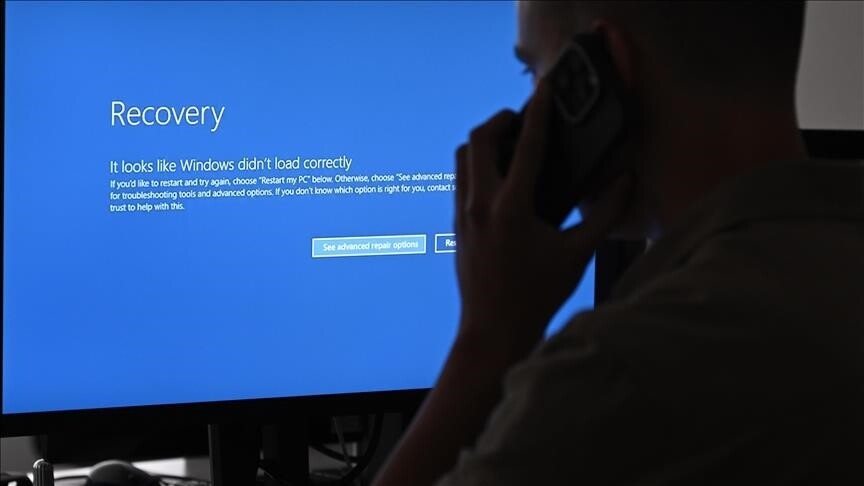
Microsoft’s workplace tools went down around the world. The next day, flights across the US were grounded for hours. By Monday, customers of some of the country's biggest banks were reporting problems accessing their accounts.
The disruptions came in quick succession as AI developers and cybersecurity specialists warned that increasingly powerful artificial intelligence could make digital systems harder to defend.
But did AI have anything to do with the failures?
The experts interviewed by Anadolu offered no evidence that AI directly caused the outages. But Steven Murdoch, professor of security engineering at University College London, warned that its influence could be less visible.
By helping attackers find and exploit software weaknesses faster, AI may be forcing engineers to rush fixes, increasing the risk of new failures, he said.
“AI only appears to have played a role in some of these outages, and mostly only indirectly,” Murdoch said.
Companies and officials have pointed to technical problems.
Microsoft attributed its outage to a previously undetected software bug that was exposed by changes in network traffic, while the Federal Aviation Administration (FAA) said routine equipment upgrades had destabilized its aging telecommunications network, adding that the new SMART AI system was not responsible.
JPMorgan Chase blamed a software bug for delays in processing transactions, while the National Security Agency (NSA), which saw internal systems disrupted Tuesday, said its internal communications systems were disrupted during scheduled maintenance.
Director of National Intelligence Jay Clayton later confirmed that the NSA outage occurred as the agency installed patches for critical software vulnerabilities discovered with the help of AI tools.
AI tools are discovering vulnerabilities faster while also helping attackers exploit them more quickly, Murdoch said, compressing the time available for defensive action.
“As a result, teams that are responsible for fixing software are not able to spend as much time ensuring that fixed software doesn’t introduce new problems.”
Microsoft CEO Satya Nadella raised similar concerns Wednesday at The New York Times DealBook Summit, warning that AI could contribute to more outages as companies race to address security threats.
AI could enable “essentially a nation-state level persistent attacker going after you all the time, so that means we have a lot of fragility,” he said.
Microsoft, however, ruled out AI as the cause of its own outage.
A fresh security warning this week illustrated the urgency facing software maintenance teams.
On Nov. 17, the US Cybersecurity and Infrastructure Security Agency urged organizations to immediately patch a vulnerability in Java software that could crash affected systems and potentially allow attackers to run code remotely without authentication.
CERT-EU, the cybersecurity service for EU institutions, issued its own advisory the following day, recommending that organizations prioritize internet-facing applications.
Saman Zonouz, an associate professor at the Georgia Institute of Technology’s School of Cybersecurity and Privacy and School of Electrical and Computer Engineering, stressed that publicly available information does not establish direct AI involvement.
“I have not seen public evidence that AI or AI-generated code caused any of them,” he told Anadolu.
“The common thread is a pattern rather than a cause; in large, tightly coupled systems, one routine change or fault can spread quickly,” he added.
The director of National Intelligence told lawmakers Wednesday that officials had found no indication of a coordinated attack.
“Based on what we know today, after a great deal of diligence, these are separate service outages associated with maintenance and technical changes. They are not a coordinated or state-sponsored attack,” Clayton said during a House Homeland Security Committee hearing.
Zonouz also rejected suggestions that the disruptions showed planned AI experiments had gone wrong.
“Two incidents followed planned infrastructure upgrades, but I see no evidence of AI tests going wrong,” he said.
He said change records, deployment and rollback timelines, system logs and post-incident reports would help establish what happened.
“With AI-assisted coding now widespread, only the published root-cause reports can fully settle this,” Zonouz said.
Murdoch cautioned that engineers restoring services may not immediately understand every factor behind a failure. Detailed investigations could take weeks or months, he said, and their findings might never become public.
Growing dependence on a small number of technology providers also makes failures more disruptive and noticeable, even when individual incidents have separate causes, he added.
The pressure to find and repair vulnerabilities has also drawn attention in the US Congress.
Democratic Sen. Maria Cantwell and Republican Sen. Mike Rounds wrote to Clayton on Tuesday, urging the White House to strengthen defenses against AI-enabled cyber threats.
“The fundamental problem is that AI can discover software weaknesses and help attackers exploit them faster than many organizations can respond,” they wrote.
“Even when fixes are available, testing and installing patches across interconnected systems can take weeks or months, potentially disrupting essential services.”
The senators called for stronger protection of critical infrastructure, financial institutions and widely used software, alongside security standards for autonomous AI systems.
Meanwhile, US President Donald Trump downplayed the disruptions when questioned Tuesday, saying: “It’s life.”
His administration has made accelerating AI development and deployment a central policy objective.
Its July 2025 AI Action Plan outlined more than 90 federal policy actions, including removing regulatory barriers, speeding infrastructure development and expanding exports of American AI technology.
Asked about the risks surrounding that push, Zonouz said the outages primarily highlighted the challenges of integrating new technology into aging infrastructure.
“These outages say more about adding new technology to aging infrastructure than about AI itself,” he said.
“Whatever the pace of AI adoption, the goal should not be bulletproof AI but systems that keep operating safely when AI or software fails.”
He called for staged deployments, tested procedures for reversing changes, manual fallbacks, human oversight of safety-critical decisions and transparent incident reporting.
Murdoch said AI does not eliminate the need for established software engineering practices, including sound system architecture, code review, testing and verification.
He argued that companies need stronger incentives to prioritize dependable services and invest in long-term stability, citing regulation, liability for failures, candid information sharing and competition among technology providers.
“The proper use of AI could result in better systems, but poor usage will result in faster development but poor-quality results,” he said.
news_share_descriptionsubscription_contact

contact_the_ombudsman
is_there_an_error_in_this_story