Melike Pala
15 June 2026•Update: 15 June 2026
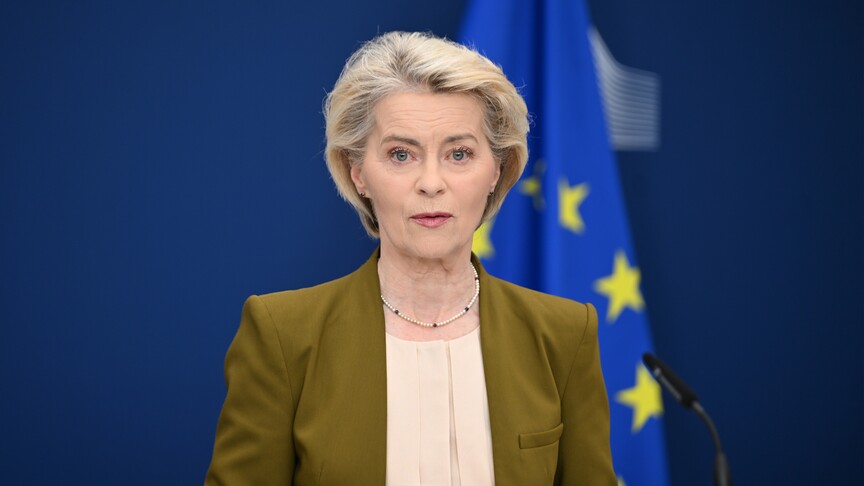
European Commission President Ursula von der Leyen said on Monday that EU sanctions on Iran will not be lifted unless there is "credible and verifiable" behavioral change on human rights violations and weapons of mass destruction programs.
Speaking at a joint press conference in Evian alongside European Council President Antonio Costa ahead of the G7 summit, von der Leyen said the European Union's sanctions framework is designed to respond to specific concerns and remains in place until measurable change is observed.
"The principle of sanctions is that we need real change on the ground before we can think about lifting them. Sanctions are in place to change behavior, so if behavior is changing credibly and verifiably, then you can lift sanctions, but the other way around is also true," she said.
"As long as there is no behavioral change, you cannot lift the sanctions because of human rights violation and weapons of mass destruction," von der Leyen further added.
Her remarks came after she welcomed a recently announced agreement between the US and Iran, saying implementation would now be the key priority.
Von der Leyen also said the agreement could help de-escalate tensions in the Middle East and reiterated calls for freedom of navigation in strategic waterways, including the Strait of Hormuz, which she said must be reopened "toll-free" to support global economic stability.
She further warned that energy dependency has repeatedly been "weaponized," adding that the European Union is working to diversify and strengthen alternative export routes to reduce strategic vulnerabilities.
Costa said the upcoming G7 summit will focus on strengthening global economic cooperation and addressing multiple security and humanitarian crises.
He said discussions would include coordinated responses to the Ebola outbreak in the Democratic Republic of Congo and Uganda, as well as efforts to improve online safety for children and teenagers in the digital environment.
Costa also highlighted the situation in the Middle East, saying the EU welcomes the US-Iran agreement and hopes it could contribute to ending conflict and restoring stability, while stressing the importance of addressing the humanitarian situation in Gaza and advancing a two-state solution.