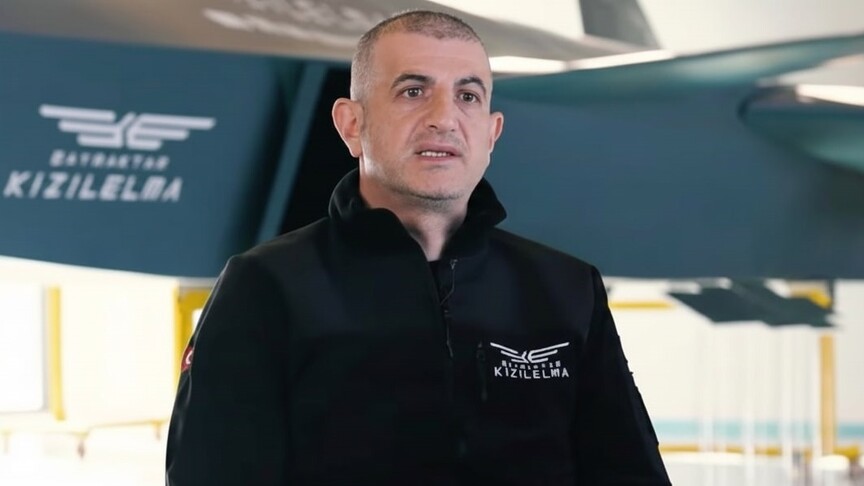
- 'One year on, we have kept the promise — and gone further,' says Haluk Bayraktar, CEO of Baykar and chairman of Piaggio Aerospace
Turkish aerospace giant Baykar has outperformed its first-year targets for Piaggio Aerospace, surpassing initial commitments in production, employment, investment, and industrial restructuring following its acquisition of the Italian aviation firm.
According to a statement from Piaggio Aerospace on Wednesday, the company has restored operational continuity, preserved its workforce, approved a new industrial plan and launched a comprehensive product and brand relaunch since it began operating as Baykar Piaggio Aerospace on July 1, 2025.
Baykar completed the acquisition on June 30, 2025, after a sale agreement was signed with Italy’s Ministry of Enterprises and Made in Italy in December 2024 and “Golden Power” approval by the Italian prime minister’s office.
The deal gave Piaggio Aerospace, founded in 1884, a permanent capital structure and long-term industrial owner after nearly seven years under extraordinary administration.
Baykar has injected by April 2026 an amount significantly higher than originally planned to sustain operations, modernize products, preserve employment and finance a deeper turnaround than initially anticipated, the statement said.
The investment has already exceeded the total multi-year cash requirement foreseen in the acquisition plan, it added.
The company also fulfilled its employment commitment. Against a pledge to retain around 675 employees, the workforce stood at 677 as of April, with new hires balancing natural departures.
Baykar has acted simultaneously as a strategic investor, turnaround financier, industrial partner and guarantor of Italian aerospace jobs, the statement said.
“When we acquired Piaggio Aerospace, we made a promise to its people, to Italy, and to the aerospace sector. One year on, we have kept the promise — and gone further,” said Haluk Bayraktar, CEO of Baykar and chairman of Piaggio Aerospace.
“We have invested well beyond our commitments, protected every job we pledged to protect, and given this 140-year-old company a new industrial plan, a new identity, and a new future. Piaggio Aerospace’s best days are still ahead,” he added.
Relaunch of P.180 platform
Piaggio Aerospace’s board approved in March 2026 a new industrial plan outlining the path to stabilization and growth.
The company unveiled its new brand identity, Avanti Next, on Feb. 28 and announced the Avanti NX, the latest evolution of the iconic P.180 Avanti twin-turboprop aircraft.
As part of the broader platform evolution, the P.180’s special missions variant was rebranded as Mantide in 2026.
The Avanti NX and Mantide now form a coordinated product family aimed at supporting future upgrades and long-term platform development.
Baykar and Piaggio Aerospace see renewed potential in the P.180, which combines jet-like speed, a large quiet cabin, fuel efficiency and a low environmental footprint.
In response to growing demand and renewed interest in the aircraft, Baykar has set a target to scale production to 20 to 25 aircraft per year by using existing facilities, infrastructure and supply-chain capacity.
Production continued throughout the stabilization phase, while the future of the P.180 was secured through active management of a supply chain inherited after years of underinvestment.
The statement said future industrial developments will be assessed in line with market demand and conditions.
Piaggio Aerospace’s EASA-certified design, production and maintenance capabilities provide a base for potential future manufacturing activities within the Baykar Group, while the company remains committed to its standalone civil aerospace and maintenance operations.
Engines, maintenance and aftermarket growth
The company’s Engine Division has also performed strongly, securing new machined-parts work packages expected to generate turnover from late 2026.
It has also advanced maintenance, repair and overhaul, or MRO, negotiations with Italian and international customers across nine active engine programs.
Current activities include MRO engine support for the Italian Air Force’s MB-339 fleet and the Italian Army’s CH-47 Chinook and A129 Mangusta fleets, as well as component manufacturing for the F-35’s F135 engine.
In aircraft maintenance, Piaggio Aerospace continues to support a fleet of P.180 aircraft under contracts with Italian government agencies.
An aftermarket growth plan is also underway, including a US spares-warehouse agreement nearing finalization and the expansion of the Pratica di Mare maintenance organization team in Rome from eight to 16 specialists.
The company said the turnaround of a business emerging from almost seven years of extraordinary administration remains challenging, with both the scale of the problems and the time needed to resolve them exceeding initial expectations.
However, it said the strategic rationale behind the acquisition remains valid, with production preserved, employment protected, a new industrial plan in place, and products being modernized and relaunched as Piaggio Aerospace builds the foundations for sustainable profitability and a renewed position in the global aerospace market.