- Experts say climate phenomenon creates conditions for fires to spread rapidly, while land clearing and peat drainage remain crucial human factors
- Indonesia’s 2026 fires remain well below catastrophic 2015 levels, but authorities warn peak dry season could keep risks elevated
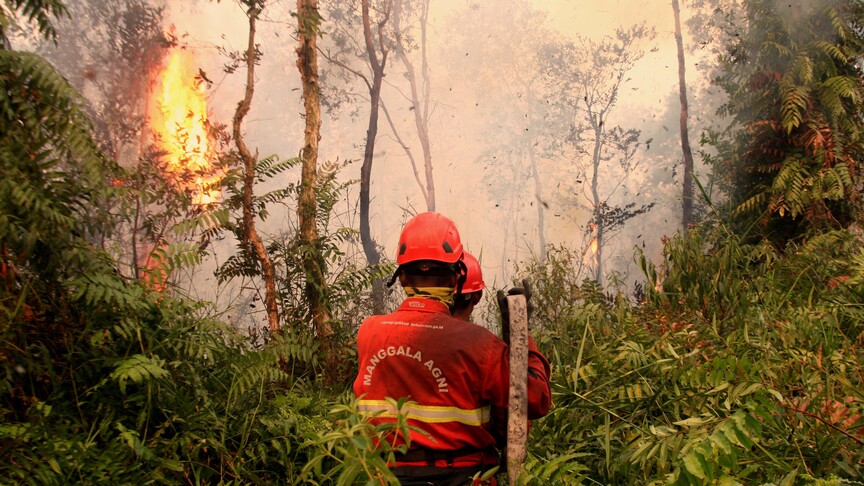
Indonesia is confronting another dangerous season of forest and peatland fires, intensified by an unusually prolonged dry season and a powerful El Nino.
Nearly 95,000 hectares (235,000 acres) were burned in July alone, according to government data, almost doubling the area damaged during the first six months of 2026.
By the end of July, the Forestry Ministry put the total area burned this year at about 202,000 hectares.
The figures have revived memories of Indonesia’s previous catastrophic fire seasons, particularly 2015, when flames swept through forests and carbon-rich peatlands, producing a regional haze crisis.
Officials say the 2026 fire season is serious, but it has not yet reached the scale of 2015.
In 2015, around 2.61 million hectares burned, compared with 1.64 million hectares in 2019 and 1.16 million hectares in 2023.
This year, however, the climatic backdrop is particularly worrying. Indonesia’s Meteorology, Climatology and Geophysics Agency (BMKG) said El Nino has reached a very strong intensity, while much of the country is experiencing unusually low rainfall.
By early August, 76.5% of Indonesia’s seasonal zones had entered the dry season. Low rainfall affected more than 90% of the country, while 87.28% of areas were recording below-normal rainfall, according to the agency.
Fachri Radjab, the country's director of climate change, told Anadolu that the drier-than-usual weather is a cause for concern.
“As a climatologist, I can confirm that this year Indonesia has a drier-than-normal and longer-than-normal dry season,” he said.
How El Nino creates conditions for fire
El Nino is a recurring climate phenomenon associated with unusually warm surface waters in the central and eastern tropical Pacific.
Its effects vary around the world, but in Indonesia it commonly suppresses rainfall, producing hotter and drier conditions.
The consequences can be dramatic during Indonesia’s dry season. Vegetation loses moisture, rivers and wetlands recede and peatlands -- enormous deposits of partially decomposed organic matter -- become increasingly vulnerable to fire.
Berton Panjaitan, a spokesperson for Indonesia’s National Disaster Management Agency, said El Nino effectively prepares the landscape for fires.
“El Nino intensifies the risk of forest and peatland fires by creating hotter and drier conditions, reducing rainfall and drying out vegetation and peat,” Berton told Anadolu.
“This makes the landscape much more flammable, so fires can start more easily and spread faster.”
Peatlands present a particular challenge. Unlike ordinary vegetation fires, peat can burn underground, meaning extinguishing visible flames does not necessarily put out the fire.
“Even when flames appear to be extinguished, heat and embers can remain underground and reignite later,” Berton said.
During prolonged drought, falling water tables expose and dry deeper layers of peat, allowing fires to move underground across larger areas.
“This is why peat fires require not only surface suppression, but also sustained water application, cooling and monitoring to prevent re-ignition,” he added.
Indonesia’s government had warned before the fire season that 2026 would be unusually difficult. The agency forecast a dry season both longer and drier than normal, with the peak expected across much of the country between July and September.
El Nino is amplifier, not only cause
Climate alone does not explain Indonesia’s recurring fire problem.
Forest and land fires have long been associated with human activity, including burning vegetation to clear land cheaply for agriculture, as well as deforestation and drainage of peatlands.
Once drained, peat loses moisture and becomes extraordinarily vulnerable to fires during drought.
Berton cautioned against treating El Nino as the sole culprit.
“El Nino is an important factor because it makes the weather drier and increases the risk of fire. But we should not blame El Nino alone,” he said.
“Human activities are also important, especially land clearing and peatland drainage.
“When dry weather and human activities happen together, the fire can spread much faster and become more difficult to control,” Berton added.
With much of Indonesia still passing through the peak dry-season period, authorities are strengthening ground operations and monitoring across Sumatra and Kalimantan.
El Nino may be beyond human control, but the conditions it creates do not have to become a fire crisis. Better land management, tighter controls on burning and stronger protection of peatlands can reduce the risk when the climate turns dry.