Yasin Gungor
08 September 2026•Update: 08 September 2026
A cargo plane that overran a runway at Miami International Airport, killing five people, was on its third mission of the day when it crashed, the National Transportation Safety Board (NTSB) said Monday.
“I would describe it in one word of devastating, utter devastation,” Jennifer Homendy, chairwoman of the US federal agency responsible for investigating civil aviation accidents, told reporters.
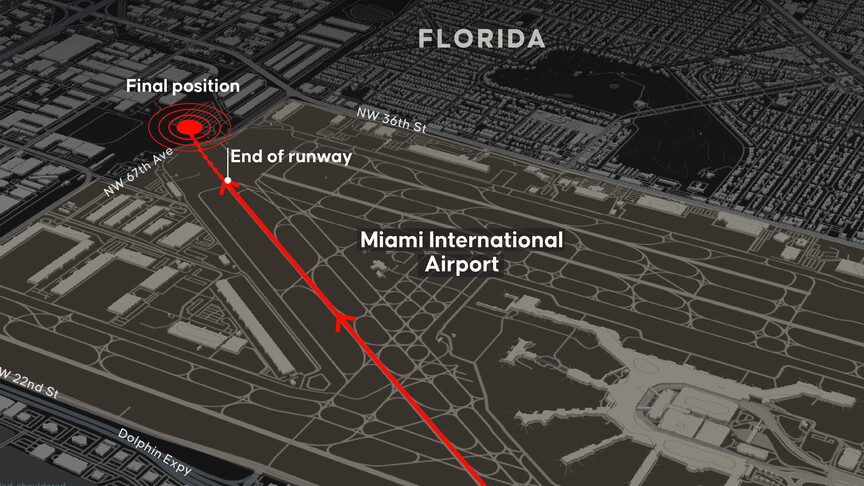
She noted that Amazon Air Flight 7598, a Boeing 767-33 Alpha aircraft manufactured in 1994, had already traveled from Cincinnati to Miami and San Juan earlier that day. Upon its final landing in Miami at 1.53 p.m. local time (1753GMT) on Sunday, the plane overran Runway 30, traveling 1,300 feet (396 meters) past the paved surface.
The aircraft struck a white Ford Econoline van carrying seven employees of a contract cleaning company before breaking through a perimeter fence. It subsequently impacted a Toyota Corolla Cross SUV on a public avenue and came to a stop near a Tesla Robotaxi station, Homendy said.
Miami-Dade County officials confirmed at least five fatalities and five injuries, with three people in critical condition.
Homendy said a 32-person NTSB team has recovered the flight data and cockpit voice recorders, which are being sent to Washington for analysis.
A major focus of the probe will be the lack of an Engineered Materials Arresting System (EMAS), a bed of crushable material at the end of runways designed to safely stop overrunning aircraft, she said. Homendy emphasized that the agency will evaluate whether such a system would have mitigated the impact.
Investigators are also examining human performance, components of the plane and the contractual relationship between Amazon and the operator, 21 Air LLC. The crash site remains hazardous due to widespread fuel spills requiring remediation.
Homendy warned that unless the agency's future safety recommendations are implemented, such tragedies will continue to occur.
The incident forced the closure of all runways at Miami International Airport (MIA), of which two of them are now open, causing significant regional travel disruptions.